
Measuring the effect of music on health requires distinguishing between subjective pleasure and what biological markers confirm. Recent meta-analyses converge on a more nuanced observation than catchy headlines: benefits exist, but their extent varies depending on the type of intervention, the patient’s profile, and the listening context.
This article compares the available data on standardized music therapy, free listening, and personalized approaches to identify where the real gaps lie.
Music Therapy and Free Listening: What Biological Markers Distinguish
Active music listening engages multiple brain areas simultaneously: auditory cortex, motor areas, memory circuits, and the reward system (dopamine release). This distributed functioning explains why music affects such different dimensions as mood, pain, or immunity.
A scientific analysis on Passez l’info details these mechanisms and their documented clinical significance.
| Criterion | Free Listening | Structured Music Therapy |
|---|---|---|
| Reduction of preoperative anxiety | Measurable effect, variable depending on patient preferences | Comparable effect, reproducible protocol |
| Cortisol regulation (stress) | Decrease observed in several studies | Decrease observed, sometimes slightly higher |
| Immune function (IgA) | Documented increase | Documented increase |
| Memory and cognitive functions (dementia) | Partial stimulation | More stable results over time |
| Cost and accessibility | Nearly zero, self-directed | Requires a trained therapist |
The table shows that the gap between the two approaches remains modest on most markers. Structured music therapy has a clear advantage, especially in complex clinical situations, particularly neurocognitive disorders.

Moderate Benefit and Heterogeneity: What Recent Meta-Analyses Say
Recent meta-analyses emphasize a point that popular content often overlooks: the benefit of music on emotional regulation is real but modest to moderate. The results are consistent for reducing stress, anxiety, and depressive symptoms. However, the heterogeneity between studies remains significant.
This heterogeneity is explained by the diversity of protocols. Some studies compare music to complete silence (which mechanically inflates the measured effect), while others compare it to an alternative relaxation activity. The type of music, tempo, volume, and duration of exposure vary considerably from one protocol to another.
For the brain, familiarity with a piece plays a crucial role. A favored piece activates the reward circuit more intensely than an unfamiliar piece, even if the latter is objectively “relaxing” according to acoustic criteria. This finding raises a methodological issue: a standardized musical intervention cannot replicate the effect of a piece chosen by the patient.
Personalized and AI-Generated Musical Interventions: What Measurable Gain
The shift from standardized music therapy to personalized interventions attempts to address this familiarity issue. Several avenues coexist:
- The selection of playlists tailored to the patient’s musical preferences, identified through prior interviews or questionnaires, which improves adherence to the protocol and activation of the reward circuit
- The use of algorithms that adjust tempo and musical mode in real-time based on physiological parameters (heart rate, skin conductance), an approach that is still experimental
- The generation of compositions by artificial intelligence, calibrated to acoustic profiles intended to enhance relaxation or cognitive stimulation
Clinically, available data show that personalization mainly improves treatment adherence. Patients listen longer and more regularly, which mechanically increases exposure and thus cumulative benefit. The intrinsic gain per minute of listening remains difficult to isolate.
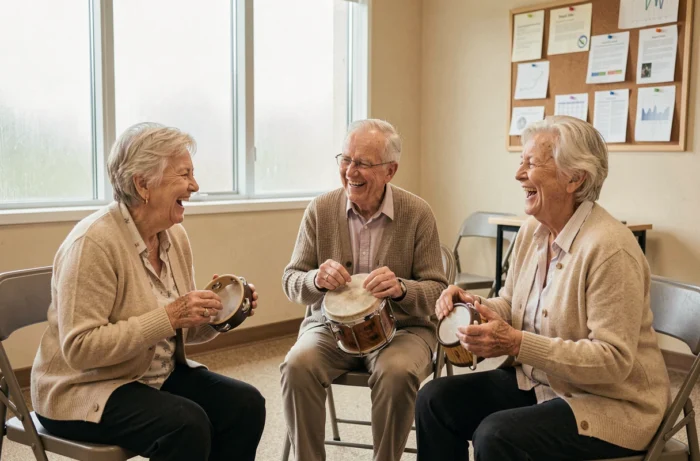
For patients with dementia, personalized music (pieces linked to autobiographical memories) shows more stable results in memory stimulation than generic pieces. This benefit relies on the joint activation of memory and emotional circuits, a mechanism that AI-generated music cannot yet replicate since it lacks a biographical anchor.
Limits of AI-Generated Compositions
AI-generated compositions optimize measurable acoustic parameters (tempo, harmonicity, dynamics). They can create a calming sound environment. However, they do not trigger the emotional response associated with recognizing a known piece, which constitutes a significant part of the documented therapeutic effect.
For contexts where familiarity is not a relevant lever (acute pain management, sound environment in recovery rooms), algorithmically generated music could offer a standardizable, low-cost solution. Evidence remains preliminary.
Music and Public Health: Where to Concentrate Resources
Reducing stress and improving mood are accessible through simple chosen music listening. Investment in structured music therapy is particularly justified for clinical populations: hospitalized patients, individuals with neurocognitive disorders, perioperative contexts.
- In palliative care and geriatrics, personalized music therapy shows the most reproducible results on well-being and reduction of agitation
- In outpatient mental health, free music listening produces effects comparable to structured interventions for mild to moderate anxiety
- In prevention, promoting instrumental practice (which engages more brain functions than passive listening) represents an underutilized lever for cognitive development and maintenance of memory functions
The debate between standard music therapy and personalized interventions does not resolve into a binary choice. The most solid data remains that regular listening to appreciated music produces measurable effects on cortisol and anxiety, without requiring costly devices. Specialized interventions add a useful layer of precision to complex clinical situations, not to the entire population.