
DIY decor is no longer just about sticking garlands on a wall or repainting a piece of reclaimed furniture. In recent years, domestic creative practices have transformed due to new regulatory constraints and a shift in habits towards workshops outside the home. Beautifying one’s daily life through handmade crafts remains accessible, but materials, techniques, and legal frameworks are evolving enough to warrant careful examination.
ESPR Regulation and DIY Materials: What’s Changing for Decoration
The European regulation ESPR (Ecodesign for Sustainable Products Regulation, EU 2024/1781), which came into effect in July 2024, extends ecodesign obligations to almost all physical goods marketed in the European Union. Furniture, textiles, paints, and chemicals used in decoration are directly affected.
For creative DIY enthusiasts, this means that supplies available in stores will gradually meet requirements for sustainability, reparability, and minimal recycled content. Decorative paints, for example, will eventually need to display a digital product passport tracing their composition and recyclability.
This framework may seem distant for someone making a driftwood photo frame on a Sunday afternoon. In practice, it is already changing the offerings on shelves: some glues, resins, and decorative sprays are being reformulated or removed. Before starting a project, checking the compatibility of products with the new standards helps avoid ending up with a material that is banned from resale or unsuitable for prolonged indoor use. Several specialized blogs document these changes, notably on https://bricolesdelouve.com/ where creative projects incorporate this practical dimension.

Creative Workshops Outside the Home: A Complement to Home DIY
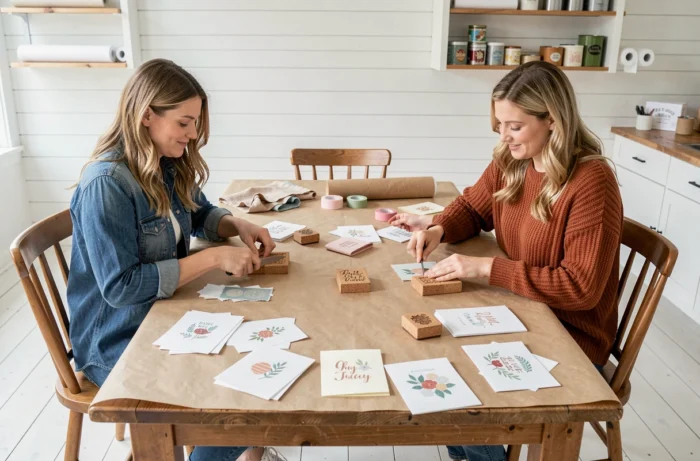
Beautifying daily life through handmade crafts is no longer limited to the living room or garage. For the past three years, structured creative workshops (ceramics, leatherwork, natural dyeing) have seen a marked increase in attendance in France, driven by those aged 25-45.
This shift changes the very nature of projects completed at home. Participants return with specific technical skills (turning, saddle stitching, glazing) that they then reinvest in their personal creations. Home DIY is gaining in finishing quality.
What Workshops Bring to Personal DIY Decoration
A few hours of ceramics class allows for the creation of containers (vases, bowls, candle holders) with a level of finish unattainable for self-taught individuals without a kiln or lathe. The pieces taken home become unique decorative elements, impossible to reproduce in series.
Structured woodworking offers a similar advantage. Access to a bandsaw or router in a shared workshop opens up possibilities that home cannot provide: custom shelves, raw wood table tops, profiled mirror frames.
Feedback on the sustainability of this trend varies. Some participants drop out after a few sessions, while others make it a monthly appointment that structures their creative practice. The common point remains the acquisition of a transferable technical skill for everyday use.
High-Impact Visual DIY Projects with Minimal Tools
Beautifying an interior or garden does not necessarily require a fully equipped workshop. A few well-chosen projects can produce a disproportionately decorative effect compared to the investment in time and materials.
Wall Decoration Without Drilling
Wall compositions made from mismatched frames, thrifted mirrors, or weavings on wooden sticks operate on a simple principle: the repetition of a pattern creates visual coherence even with heterogeneous elements. A living room wall transformed into a gallery takes an hour to set up and requires zero technical skills.
Repositionable wallpaper (in adhesive strips) allows for the modification of an entire wall section without commitment. It can be removed without leaving a trace, making it suitable for renters.
Garden and Terrace Furniture from Reclaimed Materials
Pallet wood remains a classic for outdoor DIY, but its quality varies greatly. For a durable result, three criteria deserve attention:
- Check for HT marking (heat treatment) and avoid pallets marked MB (methyl bromide), which are unsuitable for domestic use
- Always sand all surfaces in contact with skin, including edges, to eliminate splinters and treatment residues
- Apply an outdoor-appropriate oil or saturator instead of a varnish, which peels off in a few months under the elements
A well-prepared pallet garden furniture lasts several seasons without major maintenance. Sanding and choosing the right surface treatment make all the difference between an amateur result and truly usable furniture.
Decorative Painting and Furniture Customization: Technical Pitfalls
Painting remains the most accessible DIY lever for transforming an interior. A piece of raw wood furniture or a thrifted sideboard takes on a whole new look after two well-applied coats of paint. Common mistakes focus on preparation, not application.
Skipping the sanding and primer step is the main cause of premature peeling. On an old varnished or laminated piece of furniture, a bonding primer is necessary. Without it, the paint lasts a few weeks before peeling off in patches at the slightest friction.
Choosing Paint According to the Surface
Chalk paints, very popular in DIY decoration, offer an appealing matte velvety finish but require a wax or protective varnish. Without this finish, they mark with the slightest contact. Satin acrylic paints, less trendy on social media, withstand daily use better on a table or bedroom dresser.
For humid areas (bathroom, kitchen), specific anti-humidity formulations are not just a marketing argument. They contain fungicides and a denser resin that prevents blistering. Using standard paint in these areas exposes you to rapid degradation.
- Raw wood: sand with 120 grit then universal primer, two finishing coats
- Varnished or lacquered furniture: light sanding with 180 grit then bonding primer, two finishing coats
- Mélaminé or laminated: no sanding, specific bonding primer required, two finishing coats
- Metal (chair legs, lighting): degreasing, rust-proof primer if necessary, oil-based or acrylic metal paint
The temptation to skip these steps is real when seeking a quick result. Each surface requires its own preparation sequence, and it is this preparation that determines longevity.
Beautifying daily life through DIY remains a rewarding endeavor as long as one does not confuse simplicity with approximation. The most successful projects share a common trait: careful preparation of materials and a clear choice of what is feasible at home versus what is better learned in a structured setting.