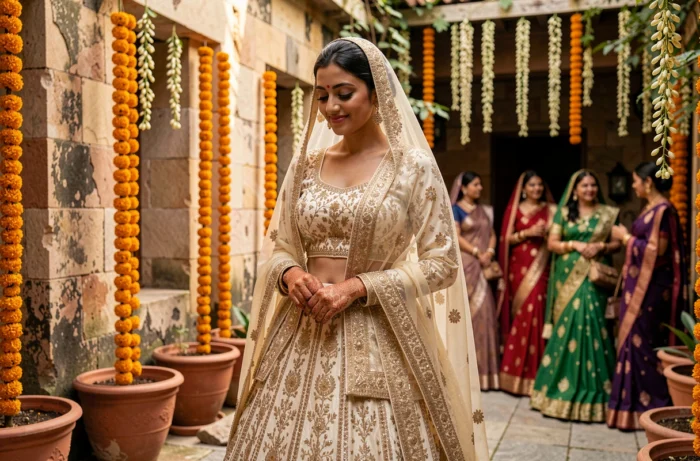
When preparing a bicultural ceremony or simply wishing to step away from the traditional flow, the challenge is not finding rituals from elsewhere. It’s knowing which ones truly work once transposed into a French context, with a reception hall, a caterer, and a guest list that does not share the same codes. The most striking wedding traditions are those that are adapted to one’s own story, not those that are reproduced like a movie set.
Adapting a foreign ritual to a secular ceremony in France
We often receive the same question: can we integrate a tradition from elsewhere into a secular ceremony without it seeming artificial? The answer lies in a simple principle. The ritual must tell something about the couple, not about the country of origin.
Let’s take the Chinese tea ceremony. In its traditional version, the couple serves tea to each family member in hierarchical order and receives red envelopes in return. Transposed during a wedding in France, this ceremony works if it retains its meaning (honoring the families) while adapting to the format.
You can reduce the number of people served, choose a tea that has a story for the couple, or replace the envelopes with a symbolic gesture specific to the family.
The same reasoning applies to the henna night from North Africa or India. There’s no need to reproduce the entirety of the pre-wedding evening with musicians, songs, and professional henna application on the entire forearm. Some couples keep only the moment when the bride-to-be receives a design on her palm, surrounded by her loved ones, with a personal playlist. The idea, on the Mariages du Monde website, is precisely to draw from this diversity to compose a coherent celebration.
Micro-wedding and world traditions: a game-changing format
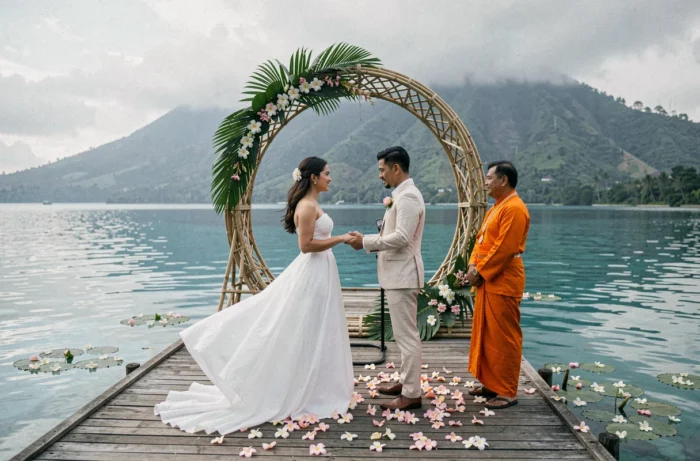
The trend towards more intimate weddings, often with fifty guests or fewer, profoundly changes the way to incorporate rituals from elsewhere. With a reduced guest list, each symbolic gesture gains intensity because all attendees see it up close.
A ritual like Celtic handfasting (tying the couple’s hands with a ribbon or fabric) takes on a whole new dimension in a garden with thirty people than in a reception hall with two hundred seats. The gesture remains visible, silence occurs naturally, and there’s no need for a microphone to explain what’s happening.
This intimate logic also encourages prioritizing participatory traditions rather than spectacular ones. Here are a few concrete examples that work in a small group:
- The sand ceremony, inspired by Hawaiian weddings, where each family pours differently colored sand into the same vase. With few guests, each participant can pour their own layer.
- The Korean pyebaek ritual, where parents throw dates and chestnuts that the couple must catch in a cloth. With a small group, it becomes a moment of shared laughter rather than a distant spectacle.
- The collective blessing, practiced in several West African cultures, where each guest pronounces a wish or advice out loud. Feasible when there are thirty, hardly manageable at one hundred fifty.
Wedding decoration and multicultural inspirations: what works on the ground
We see many Pinterest boards with table decorations labeled “Indian wedding” or “Japanese wedding.” In practice, mixing decorative codes from several cultures requires a clear thread. Without it, the reception resembles a thematic bazaar.
The most reliable thread remains the color palette. A wedding inspired by Moroccan nuptials can incorporate copper tones, deep burgundy, and golden touches without placing oriental lanterns on every table. You keep the chromatic ambiance and adapt the supports to the reception venue.
For the table, feedback varies on this point, but couples who mix two cultures often achieve the best results by reserving one strong element for each tradition rather than sprinkling them everywhere. For example: the dishes on one side (artisan ceramics from a region), the flowers on the other (arrangements inspired by Japanese ikebana or Indian jasmine garlands). One striking element per tradition avoids visual overload.
Attire of the couple: wearing traditional clothing from another culture
The question often arises in organizing a wedding from elsewhere: can one wear clothing from a culture that is not their own? The answer depends on the connection one has with that culture, not on a universal rule.
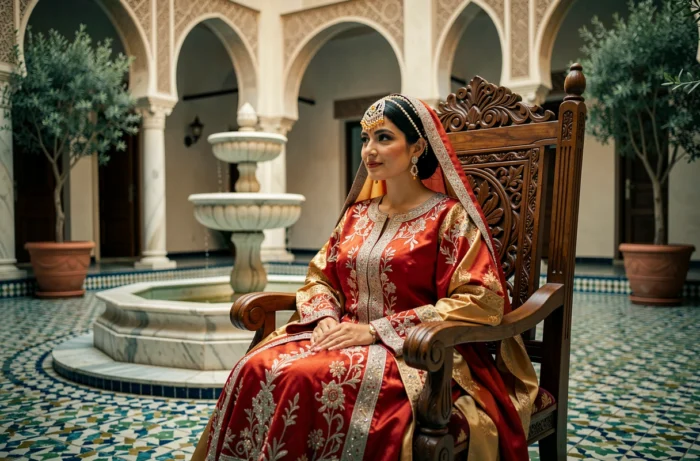
When one of the spouses has roots in another country, changing outfits during the reception is a common practice. One wears a Western wedding dress for the ceremony, then a caftan, sari, or hanbok for the evening. This outfit change marks a transition and provides guests with a strong visual moment that revives the energy of the celebration.
For couples without a direct family link to the culture in question, caution suggests drawing inspiration from a detail (embroidery, cut, accessory) rather than donning the entire traditional costume. A headpiece inspired by Berber adornments or an obi belt worn over a modern dress creates a discreet homage without risking misunderstanding.
Wedding traditions from elsewhere are not a catalog from which one randomly picks. They work when one takes the time to understand what they mean, adapts them to their own context, and accepts that the result will never be an exact copy. It is precisely this deliberate shift that makes the ceremony memorable.