
Health on a daily basis refers to the set of repeated, often mundane choices that determine the body’s and mind’s ability to function over time. Preserving this ability is not limited to avoiding illness: it is about maintaining a level of autonomy, energy, and clarity that conditions every aspect of daily life.
Non-drug prevention: a prerequisite recognized by the HAS
The Haute Autorité de santé (HAS) now positions non-drug approaches as the first line of therapy for certain chronic conditions. Diet, physical activity, combating sedentariness, and quitting smoking are no longer just ancillary recommendations: they are a mandatory prerequisite before any drug prescription, particularly in the management of type 2 diabetes.
This paradigm shift means that lifestyle is no longer a supplement to care. It becomes the foundation. A patient who sustainably changes their eating habits and activity level can delay or even avoid the need for certain treatments. To delve deeper into health essentials on Geek Medical, these active prevention mechanisms are detailed precisely.
The scope of this approach goes beyond diabetes. The same levers, with diet and movement at the forefront, reduce cardiovascular risk and slow the progression of several chronic respiratory diseases. Prevention becomes a full-fledged medical act, not just a brochure handed out in the waiting room.
Physical activity and sedentariness: two distinct variables to be addressed separately
Exercising three times a week does not compensate for eight hours spent sitting in front of a screen. Physical activity and sedentariness are two independent factors that each affect health. A person can be both athletic and sedentary if they spend the rest of their day immobile.
Physically active individuals develop about half as many cardiovascular conditions, according to data shared by the Assurance Maladie. This benefit covers strokes, coronary heart disease, and peripheral artery disease.
Breaking the sitting position is as important as training
Getting up for a few minutes every hour, walking during a phone call, taking the stairs: these micro-interruptions of sitting affect blood sugar, blood circulation, and muscle tension. They do not replace a workout, but they address a problem that exercise alone does not solve.
The practical challenge is to dissociate daily movement from the notion of athletic performance. Regular walking, gardening, and utilitarian cycling produce measurable effects on the prevention of chronic diseases without requiring equipment or a subscription.
Digital health monitoring: My health space as a prevention tool
Preserving one’s health also involves keeping a structured record of one’s medical journey. Since 2025, the public digital health record My health space has approximately 24 million activated profiles, with over 420 million documents submitted by healthcare professionals.
This centralization changes the game for individual prevention. Prescriptions, biological assessments, imaging reports: everything is accessible in one unique point. A patient consulting a new practitioner no longer has to reconstruct their history from memory, which reduces redundant examinations and follow-up oversights.
What digital tools concretely enable
- Receive screening reminders tailored to one’s age and risk profile, instead of relying solely on memory or the primary care physician
- Instantly share a blood test result with a distant specialist, accelerating the detection of anomalies before they become symptomatic
- Maintain a reliable vaccination history, particularly useful for spaced-out booster shots over several years
Digital monitoring does not replace consultations. It structures the interval between two appointments, where prevention truly takes place.

Diet and disease prevention: beyond slogans
Public nutritional recommendations have existed for decades. Their limitation rarely lies in the content (eating fruits and vegetables, limiting salt and sugar) but in their application in a real-life context: budget, preparation time, accessibility of fresh products.
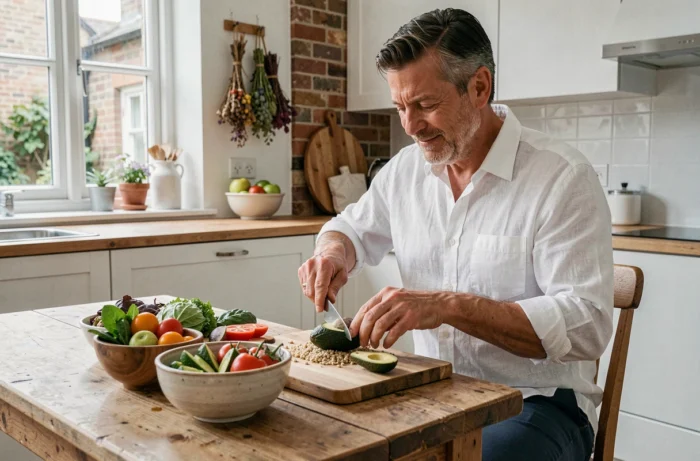
Nutritional quality is more about regularity than perfection. A balanced meal four nights a week produces more effects than a strict diet abandoned after three weeks. Food prevention works through the accumulation of ordinary choices, not through episodes of restriction.
Alcohol and tobacco: the two most modifiable risk factors
Among all prevention levers, reducing alcohol consumption and quitting smoking offer the most documented effort-benefit ratio. Cardiovascular conditions, several types of cancer, and chronic respiratory diseases share these two common risk factors.
The difficulty is not the information (the risks are known) but the transition to action. Support systems, smoking cessation consultations, reimbursed nicotine substitutes, support groups, significantly increase the chances of lasting cessation compared to an isolated attempt.
Mental health and social connection: a pillar often treated as an afterthought
Chronic stress disrupts sleep, alters eating behaviors, and weakens immune defenses. These cascading effects make stress management a physical health issue as much as a psychological one.
Social connection plays a measurable protective role. Individuals who maintain regular, even modest, interactions have a reduced risk of cognitive decline with age. Quality of life on a daily basis depends as much on the presence of a reliable support network as on the contents of one’s plate.
- Identifying a shared activity (walking, cooking, volunteering) combines physical movement and social interaction in one gesture
- Setting moments of digital disconnection protects sleep quality and reduces information overload
- Consulting a mental health professional before severe symptoms appear remains the least practiced reflex in France, despite its documented effectiveness
Mental health prevention suffers from a perceived legitimacy deficit. As long as consulting a psychologist is seen as an admission of weakness rather than a maintenance act, a significant portion of the population will remain without appropriate support.