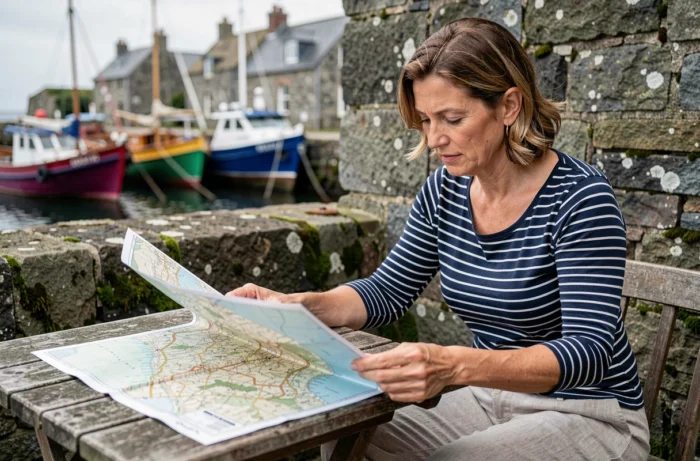
Unpacking your bags in a gîte in Morbihan or a fisherman’s house near Saint-Brieuc is not enough to experience Brittany differently. Organizing a stay in Brittany like a local means first accepting to let go of the list of the most photographed spots and adopting a different rhythm, aligned with the tides, the Tuesday morning markets, and the back roads where you encounter more tractors than camper vans.
Last-minute booking and short stays: the new Breton rhythm
In recent seasons, there has been a noticeable shortening of stays in Brittany, with about one night less on average. Last-minute bookings have become widespread, even in the height of summer. This change in tempo alters the way to prepare for a trip to the region.
To take advantage of this, we align our accommodation search with the time slots that locals know well: June and the second half of August offer a better value for money than the first half of July. September remains underrated, even though the sea is often warmer than in June.
Platforms for private rentals allow for finding last-minute availability, especially in the countryside. To compare options and spot accommodations throughout the region, one can visit https://www.bretagne-net.com/, which gathers offers covering both the coast and the inland areas.
Breton countryside: the bases of stay that visitors overlook
Brittany is increasingly presented as a refreshing alternative to summer heatwaves. This trend drives demand towards less saturated areas, far from the Pink Granite Coast or Saint-Malo in mid-August.
Settling in the bocage or a small town inland radically changes the experience. Central Brittany, around Pontivy, Lake Guerlédan, or the Brocéliande forest, allows for exploring without enduring the coastal traffic jams on weekends.
Concrete criteria for choosing your base inland
- The proximity of a town with a weekly market (bread, farm cider, vegetables) ensures food autonomy without multiplying car trips
- An accessible water point within twenty minutes – lake, river, Nantes to Brest canal – replaces the beach when you want to swim without the crowd
- The presence of a network of marked paths (GR or PR) directly from the gîte avoids having to get back behind the wheel every morning
Feedback varies on this point, but several inland hosts report that their clients return year after year, while on the coast, turnover is more pronounced.
Managing Breton weather without ruining a day
The classic reflex of visitors is to check the weather the day before and cancel the outing if rain is forecasted. A local does the opposite: we check the rain radar in real-time, not the five-day forecast. In Brittany, a morning shower rarely lasts more than an hour, and the sky can clear completely before noon.
The practical tip is to always have two options for the day: an outdoor activity (coastal path, kayaking in Morbihan, Quimper market) and a covered plan B (fish auction, pottery workshop, chapel visit). We never block an entire schedule on guaranteed nice weather.
What locals really wear
Forget the full yellow raincoat. A lightweight waterproof jacket that fits in a backpack is sufficient all year round. Locals add a thin fleece even in July for evenings at the port and keep hiking sandals rather than flip-flops, because coastal paths are often muddy even in dry weather.

Eating Breton without falling into the tourist trap
The crêperie facing the port with a menu translated into four languages is not necessarily bad. It is simply calibrated for a passing audience. To eat like a local, we apply a simple rule: follow the refrigerated trucks in the morning towards the fish auctions and markets.
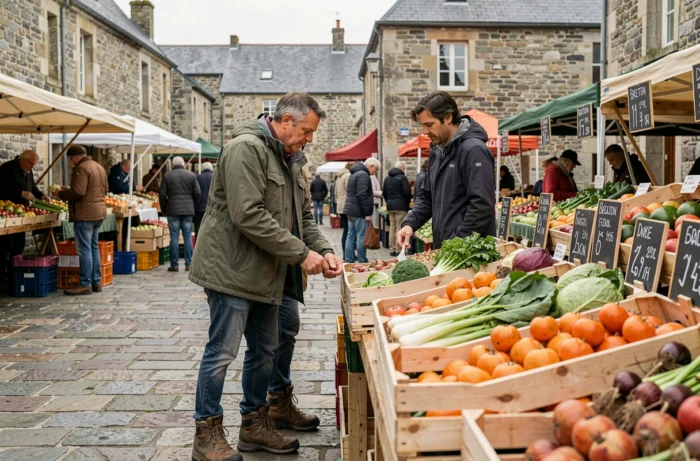
In Saint-Brieuc, Quimper, or Vannes, the covered markets concentrate local producers selling fish, oysters, Molène sausages, or far breton at prices significantly lower than in tourist areas. You will actually encounter many more Bretons than holidaymakers there.
Three local eating habits to adopt
- Buy oysters directly from an oyster farmer (Morbihan coast, Pénerf river, Brest harbor) and open them yourself at the gîte with rye bread and salted butter
- Order a bolée of farm cider rather than a bottle of wine at the restaurant: the value for money is better and it pairs naturally with the buckwheat galette
- Look for “fest-noz gastronomiques” or neighborhood meals announced at the town hall, where you can eat a kig-ha-farz or a cotriade for a few euros in a friendly atmosphere
Brittany in September, with a market basket placed on the table of a stone gîte and the window open to the bocage, has nothing to do with the summer postcard. It is precisely this contrast that makes us return, and we end up booking later and later, because we know the region keeps its promises even when the sky hesitates.