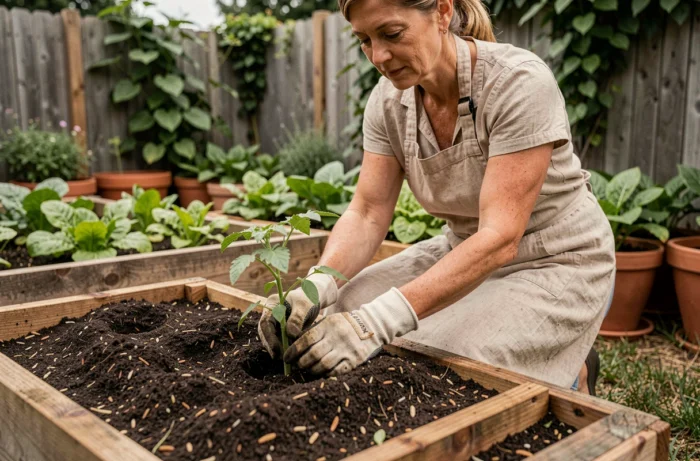
A clay soil that sticks to your boots in March, a south-facing plot that scorches everything in July, slugs that decimate young plants overnight: we’ve all experienced at least one of these scenarios. Succeeding in your vegetable garden and beautifying your garden doesn’t rely on a list of miracle recipes, but on concrete choices adapted to what is actually happening outside.
Here are the key areas that make a difference when moving from theory to practice.
Living soil in the vegetable garden: what the earth tells you before planting
Before sowing anything, take a handful of soil. If it forms a compact ball that doesn’t break apart, the soil is too clayey to directly accommodate fine seeds like carrots or lamb’s lettuce. If it crumbles between your fingers without holding together, you’re lacking organic matter.
In both cases, a layer of mature compost on the surface is often enough to correct the issue. Spread a layer a few centimeters thick and let earthworms incorporate it. Turning the soil deeply with a tiller breaks the soil structure and destroys the galleries that ensure natural drainage.
Surface composting, where you directly place fine green waste on the growing beds, continuously nourishes the soil and limits weeding. To delve deeper into these techniques and find guides by vegetable, you can consult the resource available at https://www.graine-de-jardinier.com/ which details cultivation paths suited to each type of soil.
A simple test to assess biological life: bury a cotton tea bag ten centimeters deep. After three months, if it is largely decomposed, microbial activity is good. If it comes out almost intact, the soil needs an organic boost.
Watering restrictions and the vegetable garden: anticipating a dry summer
The summer of 2026 confirms an ongoing trend. According to the official VigiEau tool, the majority of French departments are subject to water usage restrictions at some point during the season. Some municipalities go into heightened alert as early as June, with financial penalties for offenders.
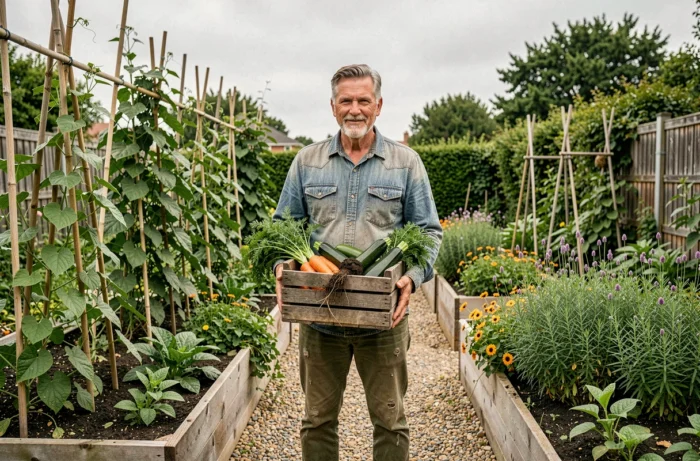
In practical terms, this changes the way a vegetable garden is conceived. Watering less often but more deeply encourages roots to go down in search of moisture, making the plants more resilient. Water early in the morning, never in the middle of the day, to limit evaporation.
Mulching remains the most effective ally. Straw, hay, wood chips, dried grass clippings: any organic cover keeps the soil cool at the base of the vegetables and significantly reduces water needs.
- Mulch to at least five centimeters thick, renewing it as soon as the layer thins out.
- Install drip irrigation instead of a traditional hose, to target each plant without wasting water.
- Favor varieties suited to drought (small-fruited heirloom tomatoes, squashes, pole beans) that better withstand water stress.
Collecting rainwater via a tank connected to the gutters provides a valuable supplement. Even a model of a few hundred liters can help during peak restrictions.
Vegetable garden integrated into the garden: mixing vegetables, flowers, and meadows
The ecological garden and the dry garden have become among the most requested styles in France since 2024. The flowering meadow, in particular, plays a direct role for biodiversity while reducing mowing and weeding work. Integrating the vegetable garden into this type of setup changes the game.
Combining edible and nectar-rich flowers with rows of vegetables attracts pollinators and disrupts pests. Nasturtiums divert aphids from broad beans. Marigolds repel certain soil nematodes. Zinnias and cosmos attract hoverflies, whose larvae devour aphids.
You can also leave a grassy strip between the vegetable garden and the fence, sown with a mix of low grasses and clover. This buffer zone shelters beneficials (ground beetles, hedgehogs) that naturally regulate slugs.
Flower borders to structure the space
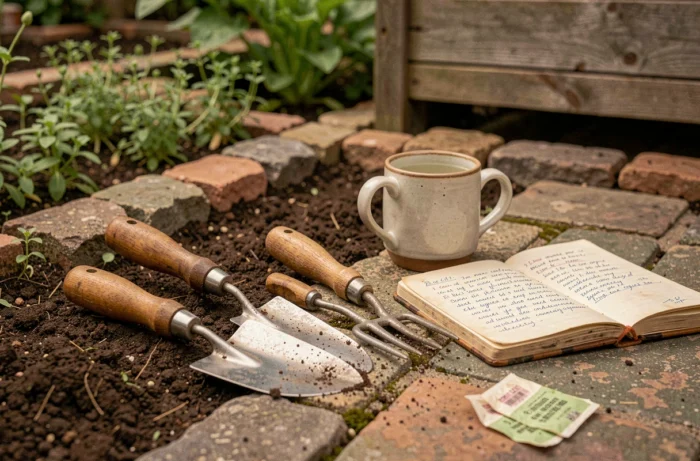
A border of lavender or rosemary along the vegetable beds serves three functions: it visually delineates areas, attracts pollinators, and withstands drought without additional watering. These Mediterranean aromatic plants thrive in well-drained soil and full sun, exactly the conditions sought by tomatoes, peppers, and eggplants as well.
Opinions vary on the effectiveness of companion plants against pests, but the impact on pollination and the garden’s aesthetics is widely agreed upon. A vegetable garden surrounded by flowers produces better than a bare vegetable garden, if only because people enjoy spending more time there.
Slug control without chemicals in the vegetable garden
Slugs remain the number one scourge of the vegetable garden, especially in spring when young plants are tender. Metaldehyde pellets are toxic to hedgehogs, birds, and pets. We can do without them.
- Physical barriers work: crushed egg shells, wood ash (to be renewed after rain), or boards placed on the ground that we turn over in the morning to collect the slugs hiding underneath.
- The beer trap remains effective but also attracts slugs from neighboring gardens. Place it at the periphery of the vegetable garden, not in the center of the crops.
- Encourage the presence of natural predators (hedgehogs, toads, ground beetles) by maintaining refuge areas: wood piles, stones, low hedges.
A vegetable garden that welcomes biodiversity manages its pests without chemical intervention. Regular manual weeding also reduces the moist shelters where slugs lay their eggs.
Seeds and plants: choosing wisely to avoid losing a season
Buying seeds suited to your region avoids many disappointments. Varieties selected for the south do not yield the same results in the north, and vice versa. Check the expiration date on the packet: seeds older than two years for sensitive species (parsley, parsnip) germinate poorly.
Starting with low-maintenance vegetables speeds up initial results: radishes, salads, zucchini, green beans. These crops forgive beginner mistakes and produce quickly, which maintains motivation. Tomatoes require more attention (staking, pruning suckers, monitoring for blight) but remain accessible from the second season onward.
For plants purchased at a garden center, inspect the bottom of the pot. Roots that spiral tightly signal a plant that has been in its pot too long. It will take longer to establish in the ground than a plant with still flexible and white roots.
The most productive vegetable garden is not the largest. Three well-maintained beds, with nourished soil, constant mulching, and varieties chosen for their terroir, will always outperform a large square left abandoned by July. The beautification of the garden follows the same logic: a few well-placed perennials transform a space more than a massive planting that is never maintained.