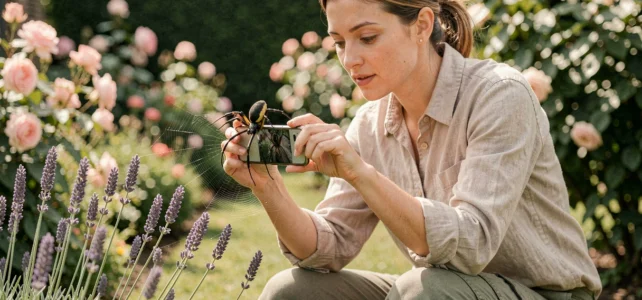
An insect lands on your arm, another munches on your tomato plants, and a third buzzes near the window. You would like to know what you’re dealing with, but paper guides are heavy and web searches are rarely conclusive. For a few years now, free apps for insect recognition have allowed you to get a reliable answer in seconds, directly from a smartphone.
AI Insect Recognition: What Happens When You Take the Photo
Before comparing the apps, it’s useful to understand how they work. You photograph a beetle on a leaf. The app cuts out the image, isolates the shape of the insect, and then compares it to a database of already identified images.
Recommended read : How to Easily Access the Montpellier Academy Webmail: The Complete Guide
This work relies on a neural network trained on thousands of photos annotated by naturalists. The larger and more diverse the database, the more accurate the recognition. This is why some apps work better on European butterflies than on tropical bugs: it all depends on the richness of the training set.
The result displayed is not an absolute certainty. The app proposes one or more likely species, accompanied by a confidence index expressed as a percentage. A high score on a clear and well-framed photo is generally reliable. A medium score on a blurry or distant shot deserves verification.
Recommended read : How to Use a Website to Find an Internship Easily and Quickly
Choosing a free app to identify insects thus comes down to evaluating the quality of this database, the relevance of the AI model, and the ease of use in daily life.
iNaturalist and Seek: Participatory or Autonomous Identification
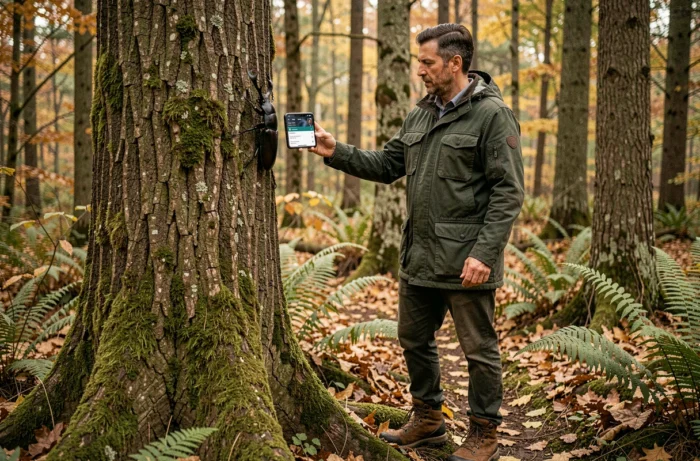
iNaturalist is a project supported by the California Academy of Sciences. Its principle is based on participatory science: you publish an observation (photo, location, date), and the community validates or corrects the identification proposed by the AI.
For field use, the associated app Seek simplifies the process. Seek uses the same visual recognition engine but works without creating an account and without internet connection at the time of taking the picture. You point the camera at the insect, and the identification appears in real-time on the screen.
Have you ever noticed that the same insect photographed from two different angles sometimes gives two distinct results? With iNaturalist, community validation corrects this bias. With Seek, you are left alone with the algorithm’s verdict. The two tools are complementary:
- Seek is suitable for family outings or quick identifications without commitment, as it does not publish anything online
- iNaturalist is preferable when you want to contribute to a naturalist inventory or obtain human confirmation
- Both apps are available on iOS and Android, completely free and ad-free
The iNaturalist database covers global fauna and flora, making it a versatile tool well beyond just insects.
Picture Insect: Instant Recognition and Practical Sheet
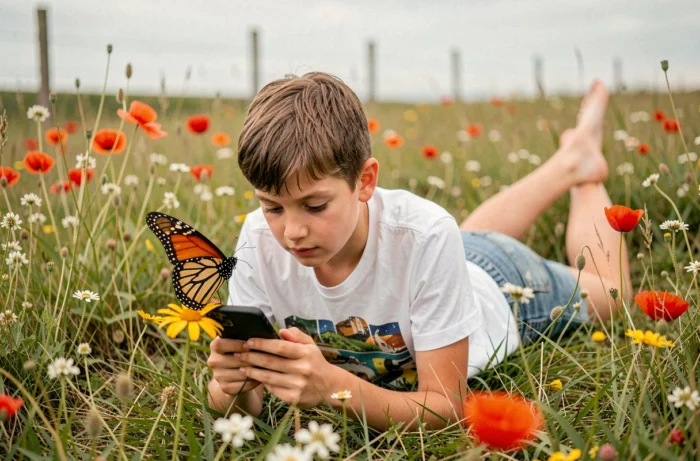
Picture Insect takes a different approach. The app is entirely dedicated to insects and spiders. You take a photo or import an image from your gallery, and the result is displayed in less than a second.
The sheet accompanying each identification contains concrete information: diet, habitat, life cycle, and especially an indication of potential danger to humans. This last point answers a common question: is the insect that just stung your child venomous?
The app is free in its basic version. Some advanced features (unlimited identification, ad removal) require a subscription. For occasional use, the free version is more than sufficient.
Why choose Picture Insect over Seek? Specialization. A model trained exclusively on insects recognizes finer details (wing veins, elytra patterns, antenna shapes) better than a general model that also covers plants and fungi.
Identifying an Insect by Sound: A Recent Avenue
Visual recognition has its limits. A cricket hidden in tall grass does not photograph easily. Recent apps are exploring a different avenue: identification by audio capture.
The principle is to record a few seconds of stridulation or buzzing. The algorithm analyzes the frequency, rhythm, and sound spectrum to propose a species. This technology is still young and currently covers a limited number of species, primarily orthopterans (crickets, grasshoppers) and some dipterans.
The practical interest is real for nighttime outings or inventories in dense environments. An amateur naturalist who hears an insect’s song in a bush can obtain a lead on identification without disturbing the animal.
Concrete Criteria for Choosing Your Insect Recognition App
Rather than downloading all available apps, focus on three criteria that make a difference in daily life:
- Offline mode: if you identify insects in the forest or mountains, an app that works without a network is a significant advantage. Seek offers this feature
- Data privacy policy: some apps collect your photos and geolocation. iNaturalist publishes your observations in open data for scientific research, which is transparent. Other apps are less clear about the use of your images
- Geographical coverage: an app that performs well on North American fauna may be mediocre on Mediterranean insects. Check user reviews from your region before committing
The most effective reflex remains to cross-reference two apps on the same photo. If Seek and Picture Insect converge on the same species, the likelihood of a correct identification increases significantly. In case of divergence, a quick search on iNaturalist with the published photo can provide a human opinion within a few hours.
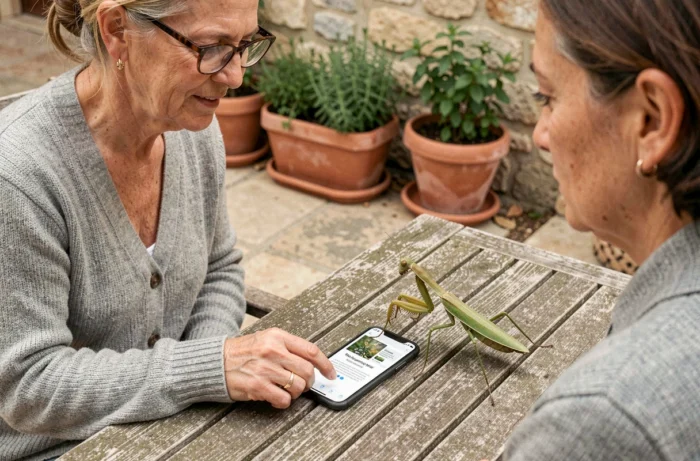
Identifying insects via smartphone does not replace the expertise of an entomologist. However, it offers a quick and accessible first sorting, turning every walk into an opportunity to learn something concrete about the species that share your garden or neighborhood.