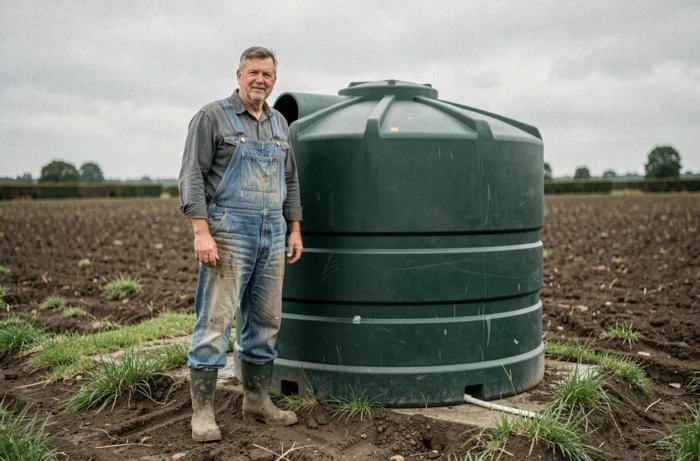
Storing rainwater on a farm reduces dependence on the grid and secures livestock watering or irrigation during dry periods. The cost of a rainwater harvesting tank remains a barrier for many farmers, but several schemes allow for significant funding. However, it is essential to know where to look: the funding sources vary according to the watershed, region, and sometimes even the municipality.
Water Agencies: The Primary Funding Lever for Agricultural Tanks
Water agencies are the most directly involved financiers for rainwater harvesting projects in agriculture. Each watershed has its own programs, with differing rates and scopes.
The Adour-Garonne Water Agency offers a specific scheme for the reuse of unconventional water in agriculture. This program, updated in September 2026, covers the collection of roof water for livestock watering. The reimbursement rate can reach 50%, and feasibility studies are also eligible.
This same Adour-Garonne basin also finances a broader “water conservation and savings in agriculture” component beyond just the tank. It includes studies, advice, and investments related to irrigation adaptation. The rate can go up to 70% for certain priority operations. In other words, a farmer who combines tank installation with optimization of their irrigation system can accumulate multiple lines of aid within the same basin.
To identify the schemes that correspond to your farm, you can compare financial solutions on Finance Factory before submitting your application to your basin’s agency.
The Loire-Bretagne Water Agency also intervenes in agricultural projects related to water management, particularly within programs aimed at reconciling livestock farming and river preservation. The specific terms vary from one call for projects to another.
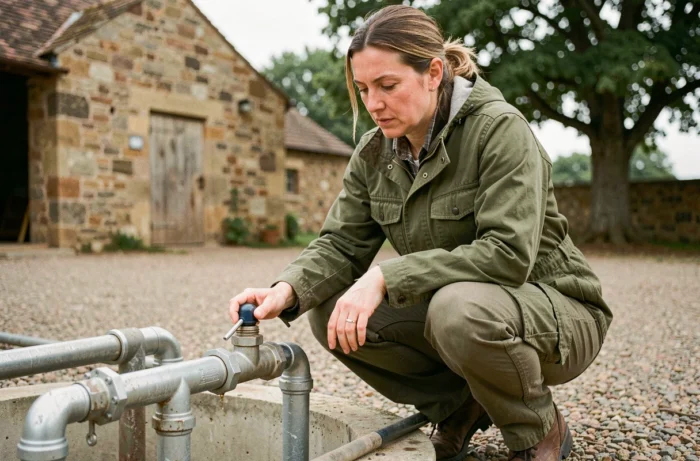
Regional and Departmental Aid for Purchasing a Water Harvester
Local authorities also offer grants for this type of equipment, often unknown to farmers.
Regions: Increasing Budgets
Brittany has announced an enhancement of its agricultural aid starting in 2026, with a specific increase for rainwater harvesters in agriculture. The announced ceiling for this regional support would rise to 32,000 euros. This amount can cover a significant portion of a large capacity installation, such as a flexible tank of several tens of cubic meters.
Other regions have similar programs, but the amounts and eligibility conditions vary from one territory to another. Visiting your regional council’s website or contacting the local chamber of agriculture remains the most reliable method to check what is available.
Departments and Municipalities: Complementary Support
Some departments directly subsidize the purchase of tanks. The amounts are generally more modest than regional aid or that from water agencies, but they can be combined with other schemes.
At the municipal or intermunicipal level, there are also schemes available. The amounts are often symbolic for a farm, but this illustrates the diversity of funding sources to approach.
Building a Solid Grant Application for Your Agricultural Project
Identifying available aid is not enough. The quality of the application often determines the success of obtaining funding.
- The application must demonstrate a direct link between the installation and a measurable water saving on the farm. A simple tank quote is not sufficient: it is necessary to quantify the volumes of network or well water that rainwater harvesting will replace.
- Feasibility studies are sometimes funded in advance (this is the case in the Adour-Garonne basin). Having a study conducted before submitting the investment application enhances the project’s credibility and can trigger an initial tranche of aid.
- The timing matters: most water agencies and regions operate through calls for projects or annual budgets. Submitting an application outside the period, or once the budget is exhausted, leads to a rejection even if the project is relevant.
- Combining aids is often possible, but each funder requires transparency regarding other grants received. Mentioning all requested aids at the first submission avoids administrative blockages later on.
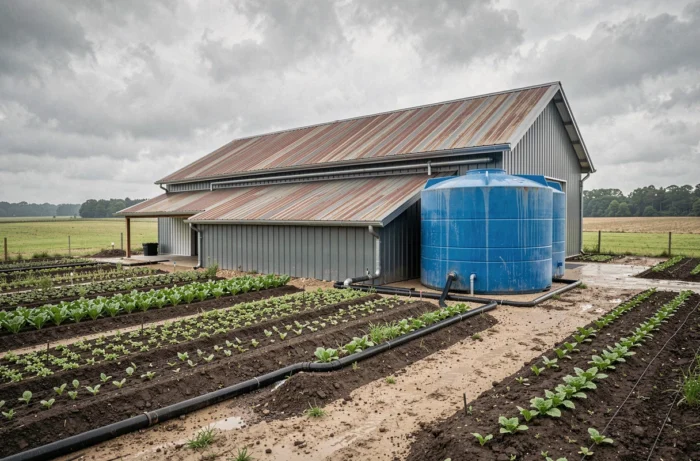
Reduced VAT and National Schemes: What Applies to Farmers
For individuals, the installation of a rainwater harvesting system benefits from a reduced VAT rate of 10% under certain conditions (housing over two years old, installation by a professional). For a farmer, the situation differs: agricultural VAT follows its own rules, and the applicable rate depends on the farm’s tax regime.
Regarding tax credits, there is currently no specific national scheme for rainwater harvesting for farmers. Previous tax credit schemes for individuals have been abolished. Thus, most public funding comes through direct grants from water agencies, regions, and departments.
The National Strategic Plan (PSN) of the CAP includes measures related to water management, but their concrete translation into investment aid for a tank varies according to regional rural development programs. Check with your chamber of agriculture if your project falls within an open measure of the PSN.
Funding for a rainwater harvesting tank in agriculture relies more on a stack of local schemes than on a single national funding source. Each farm should map out the aids available in its basin, region, and department before starting work. A well-prepared application submitted at the right time often makes the difference between a project receiving half funding and one that is entirely self-financed.