
A refrigerator with side walls that emit heat does not necessarily indicate a malfunction. On the majority of appliances produced in the last fifteen years, the condenser is no longer confined to the visible black grille at the back: it is integrated directly into the side walls, sometimes in the door. This design choice explains why the sides of the fridge heat up during the compression cycles, without any malfunction being involved.
Condenser integrated into the walls: the operation that manuals do not explain
The refrigeration circuit operates through thermal exchange. The compressor compresses the refrigerant, which turns into hot gas before circulating through the condenser to release its heat to the outside. When this condenser snakes through the side walls rather than behind the appliance, the heat is distributed across the entire surface of the casing.
See also : The reasons for the extinction of mammoths: between climate and human activity
We regularly observe that users confuse this normal dissipation with a defect. The surface temperature can reach a level significantly higher than the ambient temperature during the summer months, when the compressor runs longer to maintain the internal setpoint. This wall heat also plays an anti-condensation role: it prevents the formation of water droplets on the casing, particularly around the door seals.
To distinguish normal operation from a real problem, it is necessary to examine other solutions for hot fridge walls and cross-reference several indicators: does the compressor stop in cycles or run continuously? Does the internal temperature remain stable? Is frost accumulating abnormally?
Further reading : Change of address on the vehicle registration: procedures, costs, and possible free options
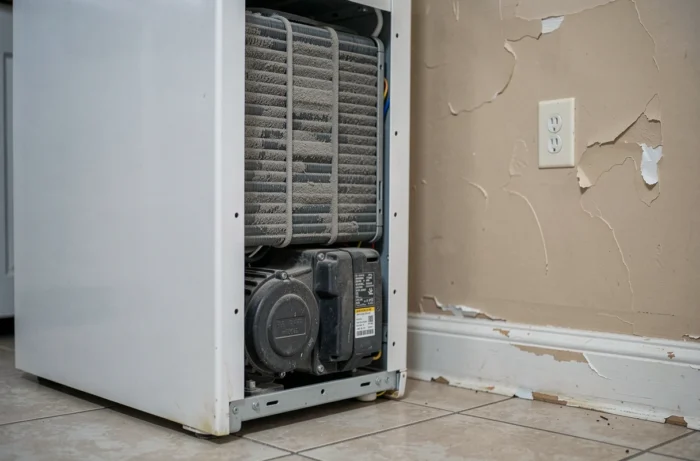
Compressor running continuously: the real warning sign of a hot fridge
A compressor that never stops is the first reliable indicator of a problem. Under normal conditions, the motor shuts off as soon as the setpoint temperature is reached, then restarts when the sensor detects a rise. A continuously running compressor forces the condenser to dissipate continuously, which overheats the walls well beyond what is observed in a standard cycle.
Several technical causes can lead to this behavior:
- A refrigerant leak in the circuit, which prevents proper thermal exchange and forces the compressor to compensate without ever reaching the setpoint.
- A faulty thermostat or temperature sensor, which sends incorrect information to the electronic board and keeps the compressor running.
- A frost-clogged evaporator, which blocks the circulation of cold air inside the appliance. Automatic defrosting is no longer sufficient, and the compressor compensates by running relentlessly.
- A worn or deformed door seal, which allows warm air to enter continuously and prevents the interior from cooling down.
We recommend checking the seal by inserting a piece of paper between the door and the casing: if it slides freely without resistance, the seal is no longer fulfilling its sealing function.
Refrigerator installation environment: the underestimated factor
A technically sound appliance can overheat due to its location. A built-in fridge without sufficient ventilation space traps heat around the condenser and forces the compressor to extend its cycles.
Several common installation errors include:
- A refrigerator pressed against the back or side wall, without the clearance space recommended by the manufacturer (usually a few centimeters on each side and above).
- A direct proximity to a heat source: oven, cooktop, radiator, or even prolonged exposure to sunlight through a kitchen window.
- A room where the ambient temperature exceeds the climatic class of the appliance. A refrigerator rated N or SN is not designed to operate in an uninsulated garage during the summer.
Moving the appliance a few centimeters or removing the adjacent heat source can sometimes significantly reduce the temperature of the walls and the compressor’s running time.

Clogged condenser and excessive electricity consumption: the direct link
On models where the condenser remains accessible at the back (often in addition to a circuit integrated into the walls), the accumulation of dust on the fins reduces the thermal dissipation capacity. The compressor then has to run longer to expel the same amount of heat, resulting in hotter walls and a higher electricity bill.
Regular cleaning of this grille with a vacuum cleaner equipped with a fine brush restores the efficiency of the condenser. We find that this operation, often neglected, is among the first checks performed by technicians during a repair. On appliances where the condenser is fully embedded in the walls, cleaning does not apply, but clearance around the casing remains crucial.
Unstable internal temperature of the fridge: when to intervene
Warm walls associated with an internal temperature that no longer drops below the setpoint is a clear signal. Before contacting a technician, three checks are necessary.
First, check that the appliance is not overloaded. A refrigerator filled beyond its useful capacity hinders the circulation of cold air and creates warm zones inside. The compressor compensates, and the walls heat up more.
Next, check the defrosting system. On a No Frost model, a faulty defrosting heater allows frost to invade the evaporator. Cold air no longer circulates, and the compressor runs continuously.
Finally, listen to the compressor. A repeated clicking noise followed by a sudden stop may indicate a failing start relay or a faulty compressor itself. In this case, the repair should be handled by a qualified refrigeration technician, authorized to handle refrigerants.
Warm-to-the-touch walls on a recent refrigerator, with a compressor that stops normally and a stable internal temperature, do not warrant any intervention. The phenomenon only becomes concerning when it is accompanied by at least one other symptom: continuous compressor, excessive frost, food that does not stay fresh, or abnormal electricity consumption. Cross-referencing these indicators allows one to distinguish between the normal physics of a refrigeration circuit and an emerging malfunction.