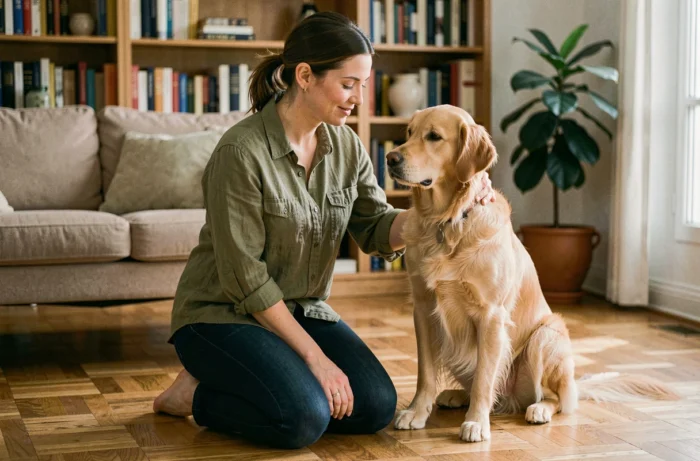
The home dog-sitting market in France has no official pricing scale. The rates displayed on platforms vary from one to three times for seemingly identical services. This opacity complicates comparison, especially since several structural factors, rarely highlighted, influence the actual cost paid by the owner.
Tax credit and SAP declaration: the true net cost of dog sitting
Most price comparisons stop at the face value displayed by the sitter. This is a methodological error. Since decree no. 2024-851 of July 25, 2024, micro-enterprises providing personal services (SAP) are exempt from the exclusive activity condition, provided that the SAP activity remains primary and that the revenue from ancillary activities does not exceed 30% of the total revenue from the previous year.
A dog-sitter declared in personal services (via the Nova declaration) can allow their private clients to benefit from a 50% tax credit on services performed at the client’s home, in accordance with article 199 sexdecies of the CGI. Comparing the home dog-sitting rates without checking the sitter’s SAP status amounts to comparing gross amounts with net amounts.
In practical terms, a sitting charged at 25 euros per night by a SAP-declared professional can end up costing 12.50 euros after the tax credit. The same service charged at 20 euros by a non-SAP-declared sitter ultimately costs the owner more. This criterion should be at the top of any comparison grid, even before the hourly rate question.

Pet-sitter’s professional liability insurance: an invisible cost affecting the price
A serious professional sitter subscribes to professional liability insurance (RC Pro). This coverage protects the owner in case of injury to the animal, damage caused by the dog at the sitter’s place, or escape during the service. The cost of this insurance is reflected in the proposed rate.
Matching platforms sometimes include insurance in their service fees, sometimes not. Other independent sitters include their RC Pro in their rates without mentioning it. The question to ask before any booking is straightforward: who covers veterinary costs in case of an incident during the sitting?
- A sitter with RC Pro generally charges more, but the owner is covered without upfront costs in case of a claim
- A sitter without RC Pro offers a lower rate, but the owner bears the financial consequences of an accident alone
- Platforms that include insurance in their commission apply a service surcharge that can represent a significant part of the final rate
Comparing only the displayed price without checking the insurance coverage is like comparing a plane ticket with luggage included and a ticket without luggage. The price tells a different story.
Dog sitting during school holidays: the seasonal variable
Home dog-sitting rates are not fixed throughout the year. During school holidays, demand skyrockets and supply dwindles. Several market sources indicate surcharges that can reach 20 to 30% during the summer or holiday season.
Booking early allows access to experienced sitters before they are fully booked. Owners who wait until a few days before departure often find themselves with a limited choice, often among the least established or most expensive profiles.
How the duration of the sitting affects the rate
Most sitters apply a decreasing rate after a certain duration. A long sitting (a week or more) costs proportionally less per night than an isolated weekend. For a two-week absence, negotiating a flat rate rather than a nightly rate can represent a significant saving.
On the other hand, very short sittings (just one night) are often charged at the full rate, or even with a surcharge. The sitter invests the same preparation and communication time for one night as for five.

Concrete comparison grid: the criteria to align before choosing
Comparing two dog-sitting quotes requires putting the same elements side by side. A low rate is not automatically a good deal, and a high rate is not necessarily unjustified.
- The sitter’s status: declared SAP self-employed (possible tax credit), classic self-employed, or undeclared individual
- The insurance coverage: individual RC Pro, platform insurance, or no coverage
- The included services: number of walks per day, administration of medications, sending photos and updates, managing a specific diet
- The period: high season (school holidays, public holidays) or low season
- The type of sitting: home visit, accommodation at the sitter’s place, or house-sitting (the sitter stays at the owner’s home)
House-sitting, where the sitter stays at the owner’s home, remains the most expensive option. Feedback varies on the value for money of this option: some owners believe that the comfort of the animal in its environment justifies the extra cost, while others consider that being with an experienced pet-sitter offers more consistent supervision.
The most reliable comparison remains one that aligns the net cost after tax advantage, the exact scope of services, and coverage in case of a problem. A personal table with these three columns, filled out for each contacted sitter, avoids unpleasant surprises when picking up your dog.