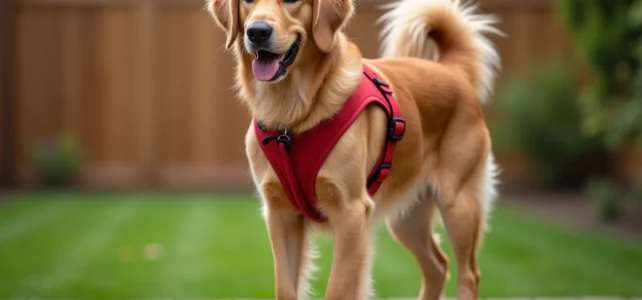
Your Golden Retriever pulls on its leash, and you feel all the tension rising in your arm. The harness seems well positioned at first, but after a few minutes of walking, it slips, rubs, or turns to the side. This discrepancy between static fitting and real-world conditions is the main trap when equipping a Golden.
The real test of the Golden Retriever harness happens after twenty minutes of walking
A harness may seem perfect in the living room. The dog is calm, the straps fall nicely, and everything seems adjusted. But the Golden Retriever is a dog that suddenly accelerates, changes direction to follow a scent, and pulls sideways as soon as it spots another dog or a body of water.
You may also like : How to Choose the Best Hairdresser for Color and Highlights in Capbreton
It’s after about twenty minutes of effort that the flaws appear. A harness that turns when the dog pulls sideways is poorly fitted, even if the size matches the label. This rotation indicates that the chest is not properly secured, and the pressure shifts to sensitive areas.
Have you ever noticed red marks or broken hairs under your Golden’s armpits after a long walk? This is a sign of repeated friction that only walking time reveals. Before choosing a harness for a Golden Retriever, you need to consider this parameter: fitting in motion is just as important as taking measurements.
You may also like : 125cc Scooter for the Highway: How to Choose the Ideal Model for Your Commutes?
A good reflex is to observe three points after twenty minutes of walking:
- The harness remains centered on the back without having pivoted to one side, even after several lateral pulls from the dog.
- No red marks or flattened fur appear under the straps, especially behind the front legs.
- Two fingers can fit flat between each strap and the skin, no more, no less. If the gap is larger, the dog can escape. If it is smaller, friction is guaranteed.
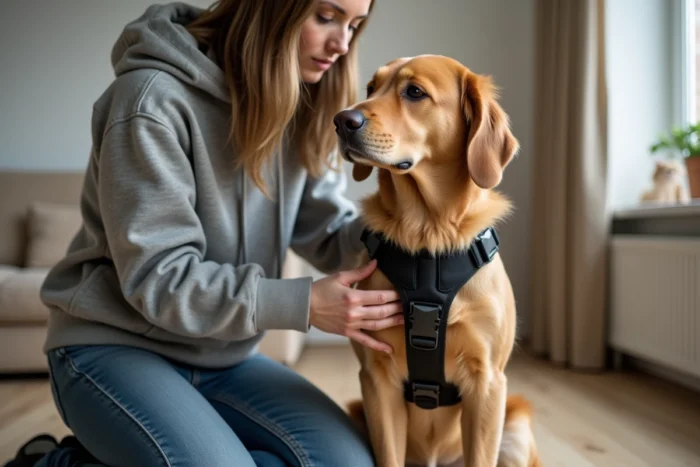
Y-shaped harness for Golden Retriever: why this shape changes everything
Not all harnesses are created equal for a Golden. The shape of the straps directly determines whether your dog can move naturally or if it is hindered with every step.
The Y-cut frees the shoulder joint. The straps descend on either side of the neck and meet on the chest, then pass between the front legs. This geometry allows the shoulders to pivot freely during walking or running.
In contrast, a harness with a strap that bars horizontally across the top of the chest (in an H or T shape) can limit the range of motion. On a Golden, which has a wide chest and muscular shoulders, this constraint causes a shortened stride. The dog compensates by straining other joints.
For Goldens that pull, a front attachment ring (on the chest) redirects the dog towards you when it accelerates. The front ring reduces pulling without applying pressure on the neck. If your Golden is rather calm on walks, a back ring is sufficient and offers more comfort on a daily basis.
Measuring a Golden’s chest circumference: the trap of thick fur
The Golden Retriever has a dense undercoat that skews the measurement. You measure the chest circumference just behind the front legs, with the dog standing and relaxed. The measuring tape should be snug without compressing the fur.
Why does this detail matter? Because the Golden’s fur can add one to two centimeters to the actual chest circumference. If you order a harness exactly to the measurement taken over the fur, the harness will be too tight once the straps are in contact with the skin. The dog breathes less easily, and friction quickly worsens.
The right method: take the measurement, then check that the chosen model still offers some adjustment margin to the next notch up. A harness with all straps already at maximum on the first day will not tolerate seasonal weight gain or a thicker winter coat.
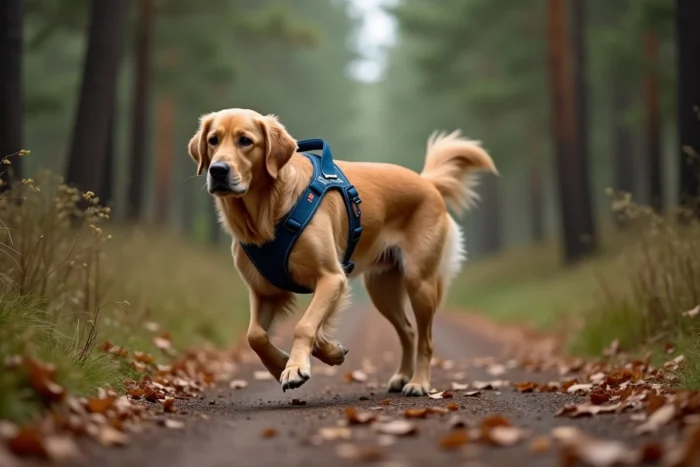
Getting a Golden Retriever used to the harness without creating aversion
A cooperative Golden can become resistant if the first contact with the harness is abrupt. Putting a harness over the head of a dog that doesn’t understand what’s happening often triggers a reflex to back away.
Gradual habituation turns the harness into a positive signal. The method works in three steps:
- Place the harness on the ground and let the dog sniff it freely. Reward with a treat every time it approaches.
- Put the harness on for a few seconds without clipping it, then take it off. Repeat several times over one or two short sessions.
- Clip the harness and take a few steps indoors before going outside. Gradually increase the duration of wear over several days.
This approach takes a few days, but it avoids daily battles at the time of departure for a walk. A Golden that associates the harness with something pleasant allows itself to be equipped without resistance.
Harness maintenance: a point that most owners neglect
A Golden Retriever loves water, mud, and wet terrain. Its harness absorbs everything. A poorly dried harness between outings causes skin irritations, especially in the folds where the skin remains damp.
Wash the harness regularly by hand with mild soap, and let it dry completely before putting it back on. Inspect the seams and adjustment buckles: a loose thread or a twisted buckle can alter the fit without you noticing.
If your Golden goes out twice a day, alternating between two harnesses allows each to dry properly. This simple rotation extends the lifespan of the equipment and protects the dog’s skin, especially during the wet months when the undercoat takes longer to dry.
Choosing a harness for a Golden Retriever is not just about size or price. It is the observation in real conditions, after several minutes of walking, that confirms whether the equipment is suitable. A well-measured Y-shaped harness, introduced gradually and maintained after each wet outing, remains the most reliable combination for this breed.