
A tile that absorbs water instead of repelling it does not always manifest as a spectacular leak. The problem often reveals itself through indirect signs: abnormal vegetation on the roof, humidity in the attic, stains on the ceiling. Measuring the porosity of a tile and choosing the right treatment requires understanding what is happening at the material level, not just at the roof level.
Comparison of treatments for tile porosity
Three main categories of products compete in the market for treating porous roofs. Their modes of action, application constraints, and durability differ significantly.
You may also like : Huawei ID: how it works and why to use it on your devices?
| Type of treatment | Principle of action | Application conditions | Estimated durability |
|---|---|---|---|
| Film-forming water repellent | Creates a waterproof film on the surface | Clean, dry surface, temperature between 5 and 25 °C | Medium (the film degrades under UV and frost) |
| Impregnating water repellent | Penetrates the pores without blocking the material’s breathability | Application until refusal with a low-pressure sprayer | Long (deep protection) |
| Anti-fungal treatment + water repellent | Eliminates moss and lichens, then waterproofs | Two distinct passes, drying time between each | Variable depending on the quality of prior cleaning |
The impregnating water repellent offers the best compromise between protection and respect for the material. The film-forming type, on the other hand, blocks the migration of water vapor: on a clay tile, this can cause bursting due to frost if moisture remains trapped inside.
To identify a porous tile on Toute La Maison, several visual and tactile criteria are detailed, from the absorption test to the inspection of the attic.
You may also like : How to Invest with Robthecoins Blockchain to Effectively Diversify Your Portfolio
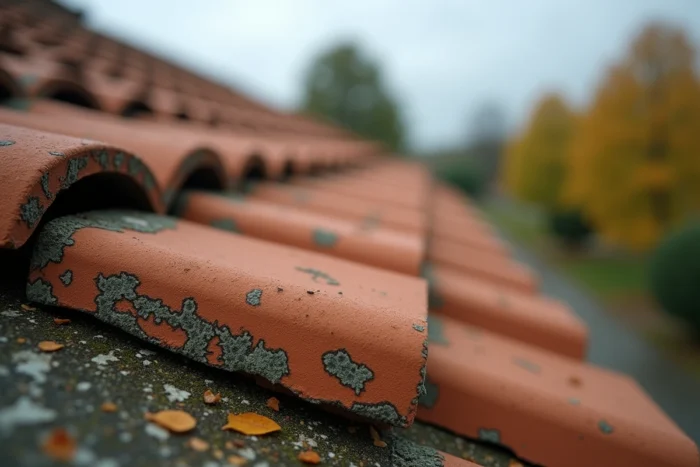
Tile porosity diagnosis: what happens before going up on the roof
Most guides start with a visual inspection from the ladder or the roof itself. The most reliable diagnosis begins elsewhere: in the attic.
Interior signs not to be overlooked
Puddles or moisture marks in the attic after rain indicate active infiltration. This symptom often precedes visible stains on the ceilings of inhabited rooms. A soaked insulation or a locally darkening framework confirms the problem.
Exterior signs and absorption test
From the ground or with binoculars, three signals should raise alarms:
- A proliferation of moss, lichens, or ferns, indicating that the tiles retain enough water to nourish the vegetation
- A marked change in color: porous tiles darken after rain and take much longer to dry than their healthy neighbors
- Visible micro-cracks on the surface, often caused by repeated freeze-thaw cycles on a waterlogged material
The simplest test involves pouring a glass of water on a dry tile. A healthy tile allows water to bead on the surface. A porous tile absorbs the liquid within seconds, and the damp area quickly spreads around the point of contact.
By tapping the tile, a hollow sound reveals a material weakened from within. In contrast, a dense tile produces a full, clear sound.
Weather window and application protocol for a water repellent on roofing
Choosing the product is not enough. A poorly timed application negates much of the benefit.
Temperature and rain-free period
Recent sources converge on a range of 5 to 25 °C for application. Below this, the product does not penetrate properly. Above this, it dries too quickly on the surface without impregnating the material deeply. Frost should be completely avoided.
After application, a rain-free period of 12 to 48 hours is required depending on the formulations. This parameter conditions the choice of the intervention period: spring and early autumn generally offer the best windows.
The “until refusal” saturation logic
The application with a low-pressure sprayer should continue until the substrate no longer absorbs. This technique, known as “until refusal,” ensures that the pores are filled with product throughout their depth. The most degraded areas often require a second pass after a short penetration time.
An improperly adjusted pressure washer can worsen porosity by stripping the surface layer of the tiles. The pressure should remain moderate, and the jet directed in the direction of water flow to avoid forcing water under the tiles.

Replacement or treatment of tiles: decision threshold
Treating porous tiles has its limits. When the material is structurally degraded (tiles crumbling in hand, thickness reduced by erosion, through cracks), no water repellent will restore waterproofing.
A recurring testimony in roofing forums illustrates this trap: a visually acceptable roof, about thirty years old, for which a professional recommends complete replacement. The owner considers a simple water repellent for a fraction of the cost. The water repellent does not compensate for a loss of thickness or structural cracks.
The decision criterion is based on the mechanical condition of the tile, not its appearance. A tile that has lost its surface material but remains dense at its core can still be treated. A crumbly tile, even clean and moss-free, must be replaced.
- Absorbent tile but mechanically sound: suitable impregnating water repellent treatment
- Locally cracked tile: unit replacement of affected elements
- Crumbly tiles over a large area: partial or total re-roofing
- Presence of moss without proven porosity: anti-fungal treatment only, without water repellent
Prior cleaning conditions the effectiveness of any treatment. A fungicidal algicide applied before the water repellent eliminates microorganisms that clog the surface and prevent the product from penetrating. Skipping this step amounts to waterproofing a layer of moss rather than the tile itself.
The porosity of tiles is not a binary defect. It evolves gradually, and the window for effective intervention lies between the first signs of abnormal absorption and the stage where the material loses its cohesion. Monitoring the attic after each rainy episode remains the simplest and most reliable preventive action.