
You are leaving your apartment and, in front of the living room chandelier, the question arises: should you unscrew the light bulbs or leave them in place? The answer can be summed up in one sentence: no French law requires you to leave the light bulbs when moving out. Legally, a light bulb is considered a consumable, just like a faucet washer or a smoke detector battery. The reality on the ground is more nuanced, as the condition report can change the situation.
Light bulbs in rental: consumable or fixture of the property
Before discussing obligations, it is essential to understand how the law classifies a light bulb. Decree No. 87-712 of August 26, 1987, lists the repairs that are the tenant’s responsibility. The replacement of light bulbs is included, alongside switches and fuses. The tenant must maintain these elements throughout the lease term.
Recommended read : Should you really follow Robthecoins' advice to start your side business?
This status as a consumable means that the light bulb is not a fixed fixture of the property, like a radiator or a water heater. You buy it, you use it, it belongs to you. In theory, you could therefore take it with you when you leave.
The question of leaving the light bulbs when moving becomes more complicated once we open the condition report file. If the entry document mentions functional light points, the landlord has the right to expect the same condition upon departure. Leaving bare sockets when light bulbs were present at entry can be considered a failure to maintain.
Related reading : Fusov in 2026: what developments and new features to expect for the platform?

Exit condition report: the real rule that resolves disputes
Article 22 of Law No. 89-462 of July 6, 1989, establishes a simple principle: the tenant returns the property in the condition it was received, except for normal wear and tear. This text does not specifically mention light bulbs. It covers everything from floor to ceiling, including light fixtures.
In practice, on the day of the exit condition report, the landlord or real estate agent compares each room with the entry document. A burnt-out or missing bulb will not cause a drama. However, several empty sockets in an apartment may justify a deduction from the security deposit.
What the landlord can deduct from the security deposit
The cost of a standard LED bulb remains modest. Disputes rarely concern the price of the bulb itself but rather the principle. A landlord who finds several non-functional light points may:
- Deduct the replacement cost from the security deposit, provided they supply a receipt (invoice or estimate)
- Note the non-compliance in the exit condition report, creating a written record in case of dispute
- Request the tenant to replace bulbs before signing the exit document
The safest way to avoid any deductions is to review the entry condition report the day before departure. If functional bulbs are listed, leave some working ones behind.
Furnished rental: stricter requirements for light fixtures
In unfurnished rentals, the question is limited to light bulbs. In furnished rentals, the situation is different. The landlord provides an equipped property, often including lamps, sconces, and light fixtures with their bulbs.
The entry condition report for a furnished rental describes these fixtures in detail. Leaving bare sockets on light fixtures that were operational upon arrival constitutes a clearer non-compliance than in an unfurnished property. In furnished rentals, each light point described at entry must be returned functional.
Did you replace a screw bulb with a more efficient LED model during your stay? Nothing prevents you from taking it, provided you replace it with a functional equivalent. The landlord cannot demand the same brand or exact model.
Sale of a property: light fixtures stay, bulbs too
The rule changes completely when it comes to sale rather than rental. When transferring a property, everything fixed to the wall or ceiling is deemed to remain in the property, unless otherwise stated in the compromise or sales agreement.
Wall sconces, ceiling lights, and recessed spotlights are part of what the law refers to as real property by destination. A seller who removes their light fixtures without prior notification before signing exposes themselves to a claim from the buyer.
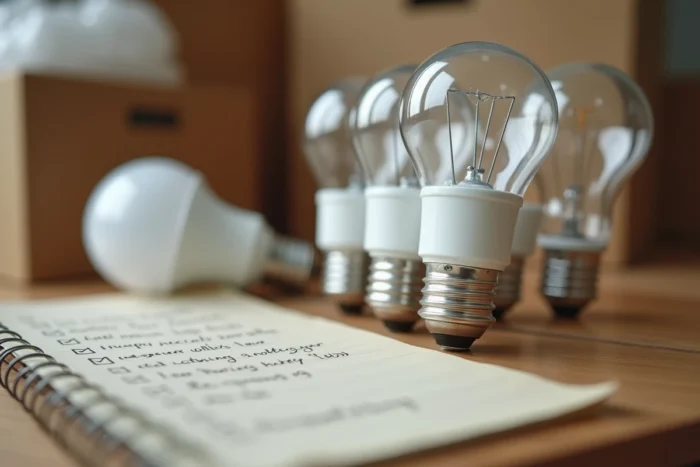
As for the bulbs themselves, no text governs the issue in the context of a sale. It is customary for the seller to leave the property with functional light points, as a courtesy and to facilitate the pre-delivery visit. Removing all bulbs from a sold apartment would be legally difficult to contest but commercially unwise.
What to specify in the sales agreement
If you wish to take a valuable chandelier or sconce, mention it in writing in the compromise. Here are the elements to check before signing:
- The list of light fixtures excluded from the sale, identified room by room
- The seller’s commitment to provide a functional light point in its place (basic ceiling light, socket with bulb)
- The deadline for removal, usually before handing over the keys
Without written mention, the new buyer may legitimately consider that all fixed equipment is part of the property.
Light bulbs and moving: good practices before the condition report
The day before the exit condition report, walk through the property, turning on each light point. Replace burnt-out bulbs with inexpensive standard LED models. Keep your specific bulbs (vintage, connected, special spectrum) and replace them with basic functional equivalents.
Photograph each room with the lights on. In case of a subsequent dispute, these time-stamped photos serve as simple and effective evidence. Compare your pictures with those from the entry condition report if available.
Disputes over light bulbs remain rare in court. They are almost always resolved at the time of the condition report, through a simple gesture: leaving a few functional bulbs. The cost of a pack of LED bulbs is negligible compared to a deduction from the security deposit, even a modest one. It is better to invest a few euros than to argue for weeks with a landlord over a matter of principle.