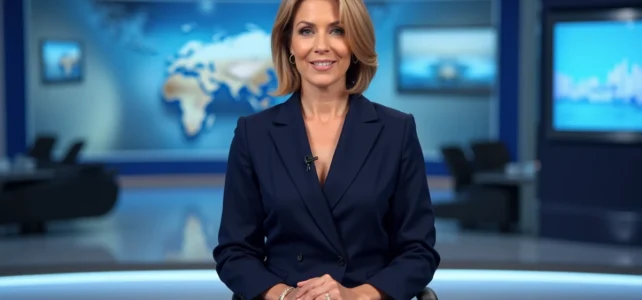
In May 2026, Aurélie Casse temporarily replaces Anne-Élisabeth Lemoine on C à vous for about fifteen days. On social media and in search suggestions, queries related to her appearance explode, far ahead of those concerning her management of the set or her interviews. This discrepancy between a journalist’s professional performance and what the public retains of her on air poses a concrete problem for television newsrooms.
Sexualizing camera shots on television: what the production teams change beforehand
Rarely do we talk about the work that happens before broadcasting. During the European Athletics Championships, broadcasters began to review images before airing to eliminate shots deemed too suggestive of female athletes. This pre-filtering shifts the responsibility: it is the production team, not the viewer, that decides what goes on screen.
You may also like : Should you really follow Robthecoins' advice to start your side business?
This principle of editorial self-censorship is not limited to sports. In talk show settings, so-called “gratuitous” slow-motion shots and cutaways to a female presenter’s legs or neckline add no narrative or technical value. The dividing line is no longer aesthetic; it is editorial: a shot must serve the argument or be cut from the edit.
When you type “thigh Aurélie Casse” into a search engine, you find results that feed exactly what the production teams are trying to correct. The question of commenting on Aurélie Casse’s legs live refers to the same mechanism: reducing a professional to a cutaway shot.
Read also : Why Business Cybersecurity Depends on a Specialized Company

Television journalist and athlete on air: why the treatment differs
Search results mix private life, couple, body, and career of Aurélie Casse. The same pattern is found for other presenters from BFMTV or France Télévisions. What is lacking in this coverage is a distinction that newsrooms are well aware of internally.
An athlete filmed in competition performs a technical gesture that justifies a close-up. A journalist conducting an interview on set has no reason to be framed on her legs. The context changes everything, and the editing should take this into account.
In sports, awareness has led to concrete production guidelines: prohibiting slow-motion shots of certain body parts, systematically reframing on the face or the athletic gesture. In television studios, these guidelines do not yet exist in a formalized manner. Feedback on this point varies across channels and shows.
What newsrooms really evaluate in a presenter
Aurélie Casse has hosted two seasons of C l’hebdo on France 5. This type of show requires the ability to manage a multi-guest set, to prompt a political guest without losing the editorial thread, and to maintain live broadcasting for an extended period. Here are the operational criteria that distinguish candidates on air:
- Conducting live interviews, ability to bounce back on an unexpected answer without dead air
- Managing the rhythm between contributors, without allowing one participant to monopolize the set
- Mastery of the script (sequence of topics, adherence to timing imposed by production)
- Ability to simplify a technical or political topic for a broad audience
None of these criteria concern physical appearance. One can find an elegant presenter without it becoming the main subject of the searches associated with her.
Gendered searches on female presenters: a measurable bias in Google
Type the name of a male presenter into Google. The suggestions revolve around his show, his salary, sometimes his background. Type the name of a female presenter and the suggestions shift towards “couple,” “legs,” “dress,” “size.”
This bias is not trivial for the careers of female journalists. Search suggestions shape public perception. A newsroom that is hesitating between two profiles for a time slot knows that the media treatment of a candidate will weigh in the balance, including how the public perceives her online.
The search volume on Aurélie Casse’s appearance is regular and stable. It is not a spike related to a one-time event. It is an ingrained reflex that recurs with each appearance on air, whether on BFMTV or France 5.
Commenting on the appearance of a television journalist: a concrete hindrance for newsrooms
When a newsroom prepares to replace a presenter, the question of public image enters the equation. Not from the angle of physical appearance, but from the angle of the “noise” that gendered searches generate around a name.
This parasitic noise creates an operational problem:
- Community managers must manage off-topic comments on the show’s social media
- Press officers steer interviews towards professional backgrounds to counterbalance Google results
- The presenters themselves adapt their attire not by editorial choice, but to limit the volume of comments on their appearance
Aurélie Casse has publicly mentioned a scar on her thigh, an intimate detail turned into a news article by the tabloids. This shift between private life and permanent spectacle illustrates the pressure that female journalists face on television.
The role of the viewer in this mechanism
Every Google search on a female presenter’s appearance feeds the algorithm and reinforces the visibility of this content. The cycle is self-sustaining: the more we search, the more engines suggest, the more sites produce content tailored to capture this traffic.
Breaking this cycle requires a collective awareness, but also concrete production choices from broadcasters. Filtering shots beforehand, as some sports production teams already do, remains the most direct measure. For studio shows, we are still at the stage of internal discussion.
The next time a Google suggestion proposes “Aurélie Casse legs” or “thigh Aurélie Casse,” the choice not to click is also an editorial choice made by the viewer.