
The European regulatory framework is reshaping the contours of what can be sold, communicated, and stored in the textile sector. The autumn-winter 2026-2027 fashion trends are not just about a color palette or updated cuts: they now incorporate structural constraints that modify the value chain, from material sourcing to in-store merchandising.
Digital product passport and textile traceability: what changes for style
The central register of the EU digital product passport was launched in July 2026. The operational rules for access and verification followed in August 2026, with a gradual rollout to textiles expected between 2027 and 2028.
For brands that build their positioning on material transparency, this passport becomes a differentiation lever. We are already seeing some houses integrating a QR code on the label linking to the traceability sheet, which enhances the value of traceable natural fiber pieces compared to opaque synthetic blends.
This requirement pushes creators to simplify their composition nomenclatures. A mixed wool coat, for which the exact share of each fiber must be documented, costs more in compliance than a single-material model. The direct consequence on collections: pieces made from virgin wool, linen, or single-source organic cotton are gaining ground in autumn-winter wardrobes, not as a fashion effect, but for industrial rationality.
To explore pieces that meet these new traceability requirements, we recommend checking the fashion page of SAV 35, which lists updated selections each season.
End of unsold goods destruction: impact on colors and collection volumes
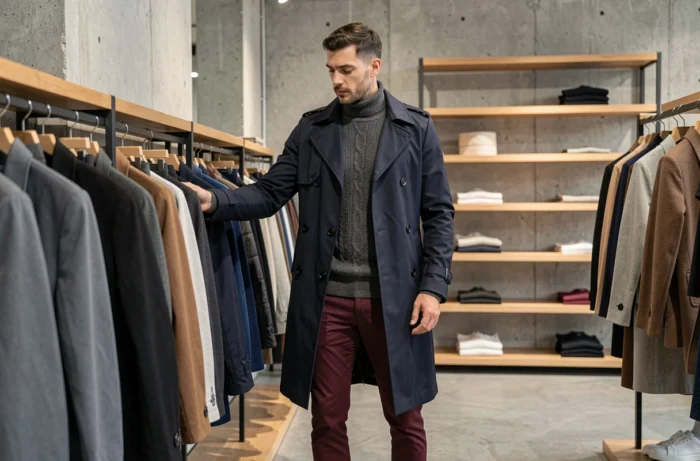
Since July 2026, the ban on destroying unsold clothing and shoes applies to large companies in Europe. This measure requires a rethink of production volumes and the depth of color ranges.
When dormant stock can no longer be sent to the dump, the financial risk shifts to confidential shades. We are seeing a refocusing on tighter palettes, with colors that have high turnover.
- Brown, from chocolate to mocha, is establishing itself as an alternative to black because it transcends seasons without aggressive marking
- Ecru and off-white allow for easy restocking and combine with the majority of pieces in an existing wardrobe
- Bright shades (cardinal red, cobalt blue) are reserved for short capsules, produced in limited quantities to avoid surplus
This mechanism explains why the autumn-winter 2026-2027 collections appear chromatically more subdued than previous seasons. Sobriety is not an isolated aesthetic choice; it is a logistical response to a new legal framework.
Environmental claims on clothing: the end of marketing vagueness
Starting September 27, 2026, generic environmental claims must be based on recognized evidence. Vague terms like “eco-friendly” or “sustainable” without documented justification will no longer be accepted on labels and communication materials in Europe.
For the informed consumer, this means that brands continuing to use these formulations after this date expose themselves to sanctions. A garment presented as “green” must rely on a certification or verifiable standard.
We recommend checking for the presence of a third-party label (GOTS, OEKO-TEX, Bluesign) rather than relying on self-declarations. This filter quickly eliminates pieces whose “sustainable trend” positioning is mere commercial discourse without technical substance.

Ultra-fast fashion and French penalties: what effect on fashion trends in France
France has taken a more aggressive approach than the rest of Europe. A reform implemented in 2026 prepares for penalties targeted at actors with very high collection turnover. The logic distinguishes classic fast fashion from ultra-fast fashion, a unique regulatory differentiation.
For brands that renew their references every week, the additional cost per piece could render some models unprofitable. Retailers like Shein or Temu are directly targeted, with levies considered on imported items.
The indirect effect on trends is tangible: when the cost of bringing a micro-trend to market increases, brands extend the commercial lifespan of each model. The barrel jeans or wide pants, for example, remain in the collection for several seasons instead of being replaced after a few weeks. Fashion trends are mechanically slowing down due to regulation, not by stylistic choice.
Cuts and key pieces for autumn-winter 2026: what the runways confirm
In terms of silhouettes, the autumn-winter 2026-2027 season confirms several technical orientations that deserve close examination.
- British-inspired tailoring returns with structured shoulders and a straight fall, suitable for layering without excessive volume
- Heavy knits (oversized sweaters, thick cardigans) are worn as main pieces rather than as underlayers, changing the relationship to outerwear
- Jeans remain central, but cuts are evolving towards straight or slightly flared models that are gradually replacing slim fits
- Mid-length dresses in textured materials (corduroy, lightweight tweed) work in autumn transition without requiring thick tights
The common point among these pieces: they prioritize durability of use. A structured coat in thick wool or a well-cut pair of jeans does not go out of style in three months. Pieces with high stylistic longevity are becoming the norm, and this convergence between design and regulatory constraint redefines what it means to adopt a modern style.
The wardrobe that is shaping up for the upcoming seasons relies less on the accumulation of ephemeral references and more on building a coherent wardrobe, where each piece supports multiple combinations. The European regulation, far from stifling creativity, pushes brands to design clothing whose value does not collapse after one season.