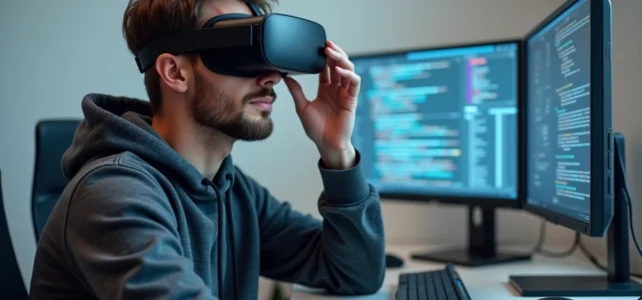
What high-tech trends are really changing the habits of geeks in 2026? Between European regulatory announcements, French identity verification technologies, and shifts in the cloud ecosystem, innovations are not limited to gadgets. This article measures three concrete developments that are game-changers for digital daily life.
Technological Sovereignty in Europe: What the Regulatory Package Changes for Geeks
The European Commission presented a legislative package focused on technological sovereignty in June 2026. Two texts stand out: the Chips Act 2.0 and the Cloud and AI Development Act.
See also : 10 Simple Tips to Enhance Your Daily Well-Being and Regain Balance
The Chips Act 2.0 allows the Commission, in case of a semiconductor shortage, to prioritize certain products deemed critical. This measure can go as far as overriding existing private contracts, with fines imposed on companies that refuse to provide their production data.
For tech enthusiasts, the consequence is direct: stock shortages on graphics cards, consoles, or DIY components could be managed differently in the future. European manufacturers would have an obligation to be transparent about their volumes, which would reduce the opacity that fuels price speculation during launches. The latest high-tech trends also come through regulatory monitoring, on platforms like geekwise.fr that track these developments over time.
Recommended read : Discover the latest trends and practical tips for car enthusiasts
The Cloud and AI Development Act, on the other hand, aims to reduce European dependence on American cloud providers. The stated goal is to promote the emergence of sovereign cloud infrastructures, which could change the storage and computing offers available to individuals and small development studios.
| Measure | Chips Act 2.0 | Cloud and AI Development Act |
|---|---|---|
| Main Objective | Secure semiconductor supply | Reduce dependence on non-European clouds |
| Direct Geek Impact | Fewer shortages on components and GPUs | New local cloud offers for gaming and development |
| Binding Leverage | Fines and mandatory prioritization | Regulatory framework for providers |
| Application Horizon | Gradual after adoption | Gradual after adoption |

Hand Age Verification: The French Tech Replacing Facial Recognition
An innovation developed in France allows for estimating a user’s age from an image of their hand, without resorting to facial recognition. The principle relies on the morphological analysis of the hand for access controls to restricted content (games, social networks, adult content).
The advantage of this approach lies in one specific point: it limits the risks of biometric re-identification. An image of a hand does not easily lead back to a person’s identity like a face does. For gamers and users of community platforms, this technology paves the way for less intrusive automated moderation.
Concrete use cases that are emerging include:
- Age verification on online gaming platforms, without the need to provide an ID or scan one’s face
- Access to restricted content on social networks with quick and anonymized verification
- Possible integration into mobile applications via the smartphone camera, without additional hardware
This French approach stands out from Anglo-Saxon solutions that mainly rely on facial analysis. The choice of the hand as an age marker reduces the exposure surface of personal data, a strong argument in a context where European regulation is tightening privacy protection requirements.
Multi-Angle Sports Broadcasting: How Cameras Change the Viewer Experience
Ultra-high-performance cameras deployed during sporting events now allow viewers to choose the angle they want. This technology, documented by TF1, transforms live sports consumption into an interactive experience.
The operation relies on a network of sensors placed around the field or circuit, whose streams are synchronized in real-time. The viewer selects their camera from their screen, which requires significant bandwidth and an appropriate broadcasting infrastructure.
For the geek daily life, this evolution has several technical implications:
- Internet boxes and fiber connections are challenged by heavier simultaneous streams than traditional broadcasting
- Sports streaming applications integrate navigation interfaces between angles, changing the usual ergonomics
- Virtual reality headsets become a natural extension of this type of broadcast, with increased immersion
This trend illustrates how hardware and software innovations converge towards a personalization of live broadcasts. The viewer no longer just experiences the production; they compose it.

France 2030 and Critical Technologies
The France 2030 initiative has designated new winners for the development of critical innovative technologies. This program funds French projects in areas such as semiconductors, artificial intelligence, and digital infrastructures.
For geeks following the French tech ecosystem, this funding determines which products and services will hit the market in the coming years. The France 2030 winners guide French R&D towards segments where dependence on foreign suppliers is highest.
The European regulatory package and the France 2030 investments outline a tech landscape where geopolitics weighs as much as product innovation. The coming months will reveal whether these measures truly accelerate access to more diverse components and services, or if they add a layer of administrative complexity without tangible benefits for the end user.