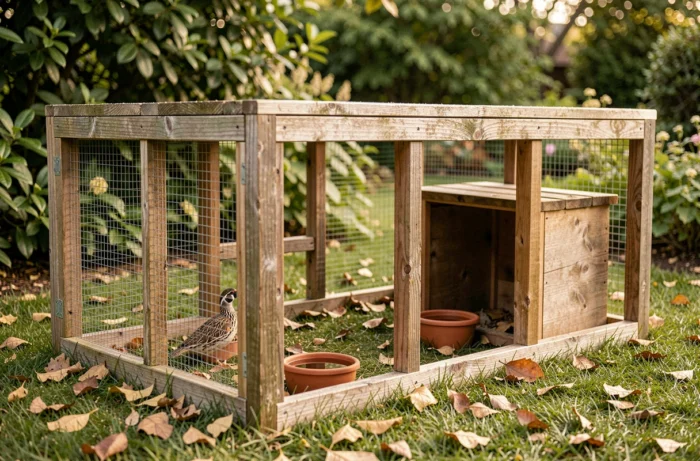
The Chinese quail (Excalfactoria chinensis) takes off vertically as soon as it is startled. This escape reflex alone dictates the geometry of the enclosure: limited height, absence of sharp edges on the ceiling, and fine mesh on each side. Everything else, from the bedding to the locking system, stems from this behavioral constraint.
Escape-proof enclosures for Chinese quails: closures and mesh
Field reports documented in 2025 converge on one point: the majority of escapes result from a closure defect, not from a broken mesh. A door moved by the wind or a poorly engaged latch is enough to lose an entire pair in a matter of seconds.
We recommend a double-action locking system (latch + carabiner or spring bolt) on each access point. The hinges should be oriented inward to prevent any opening from external pressure, including from a medium-sized predator like a cat or a weasel.
The mesh deserves special attention. A mesh with a maximum of 12 mm prevents chicks from passing through and blocks the introduction of a mustelid’s paw. Standard rabbit mesh is suitable for the walls, provided that there are no gaps around the perimeter, at ground level, and at corner junctions. Each connection must be tied with galvanized wire, not just overlapped.
For the ceiling, two options stand out. A soft nylon net with fine mesh absorbs the shock of vertical takeoff without injuring the bird. A rigid mesh also works, but then it is necessary to place foam or thick fabric under the roof to cushion the cranial impact. This detail, often overlooked in general guides, prevents repeated concussions that weaken quails in the long term.
Choosing a cage for Chinese quail on Animal Passion allows you to start with a suitable structural base before adding your own predator-proof reinforcements.
Height and ground area: sizing the quail enclosure
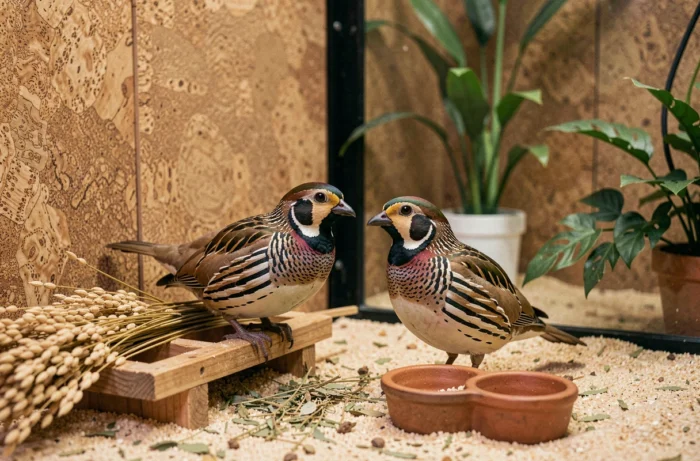
An enclosure that is too high is as problematic as one that is too low. With a high ceiling, the Chinese quail gains enough vertical momentum to fracture its skull. The appropriate height is around 40 cm for an indoor enclosure. In an outdoor aviary shared with other birds, the soft netting on the ceiling then becomes non-negotiable.
The ground area is more important than the total volume. A pair of Chinese quails needs a ground space that allows them to move, scratch, and hide without colliding. Structures of 60 x 40 cm are a strict minimum for a pair. Beyond two individuals, we observe that territorial stress significantly increases if the area is not doubled for each additional pair.
Ground layout of the enclosure
The Chinese quail lives exclusively on the ground. The bedding must be absorbent and dust-free. Chopped hemp or corn husks work well. Wood shavings from conifers should be avoided: phenols irritate the respiratory tracts of these small birds.
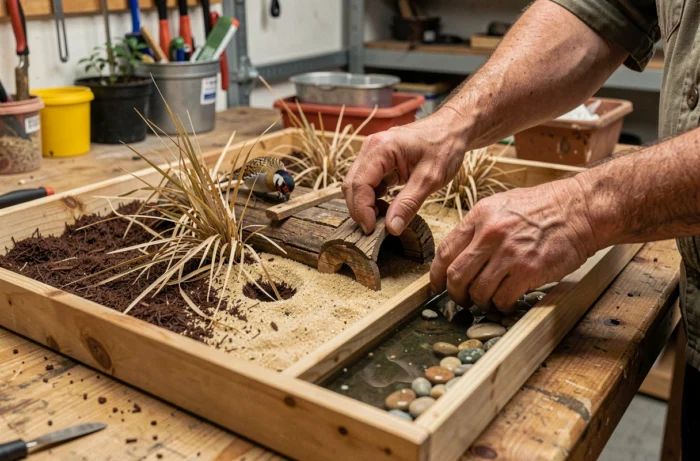
- Place clumps of dry grasses or flat pieces of bark as micro-shelters, as quails take refuge there at the slightest alert
- Provide at least one shelter closed on three sides per pair, low enough for the bird to feel protected without being able to take off
- Include a fine sand tray for dust bathing, a regular behavior linked to feather maintenance
Regulations and health declaration for a quail enclosure
The regulatory angle is the major absent topic in amateur breeder forums. In France, keeping poultry, including quails, can trigger declarative obligations and minimum distances from neighboring homes, especially when the number exceeds that of a small family farm.
Checking the local urban planning plan (PLU) of your municipality before any installation remains the first step. Some PLUs purely prohibit farming in dense urban areas. Others impose a minimum setback between the enclosure and the property line. These constraints vary from one municipality to another, and no uniform national rule applies to small domestic flocks.
The revised IED directive in 2024 mainly concerns large-scale poultry farming, with very high thresholds for quails. An amateur breeder with a few pairs is not targeted. However, a declaration to the town hall is often required as soon as there is poultry ownership, even just for traceability reasons in case of an avian flu outbreak.
Stress-free design: light, noise, and cohabitation
The Chinese quail is a bird sensitive to sudden changes in light and high-pitched sounds. An enclosure facing a south-facing bay window generates alternations of shade and direct light that trigger panic flights. We recommend a location receiving indirect light, or the addition of a shading net on one side of the outdoor enclosure.
Noise is an underestimated stress factor. An enclosure located near a busy road, a workshop, or a kennel causes a constant state of alert. Quails stop laying eggs, lose feathers, and develop pecking behaviors towards each other.
- Avoid any location exposed to regular vibrations (washing machine, pool pump, generator)
- Do not cohabit Chinese quails with vocal or territorial species like budgerigars in an adjacent cage
- Install the enclosure at table height to limit visual intrusions from cats or dogs, which cause repeated vertical takeoffs
Cohabitation in an aviary with perching birds (Gouldian finches, canaries) works as long as the species never compete for the same spatial level. The Chinese quail occupies the ground, while the perching birds remain above. The problem arises with birds that regularly come down to the ground to feed or bathe.
A well-designed enclosure for Chinese quails should first be thought of as a closed space without structural flaws, sized for ground area rather than volume, and positioned in a quiet zone. Local regulations add a layer of constraint that most breeders discover after installation, rarely before.